Eye of Gold Slot Demo – Honest Review, RTP & Volatility
Game Overview and Basic Information
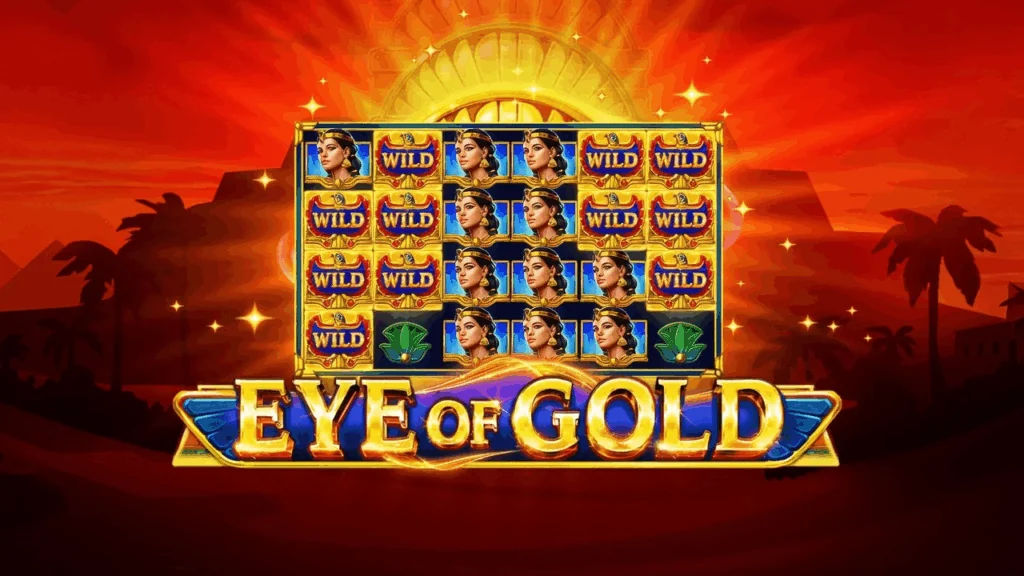
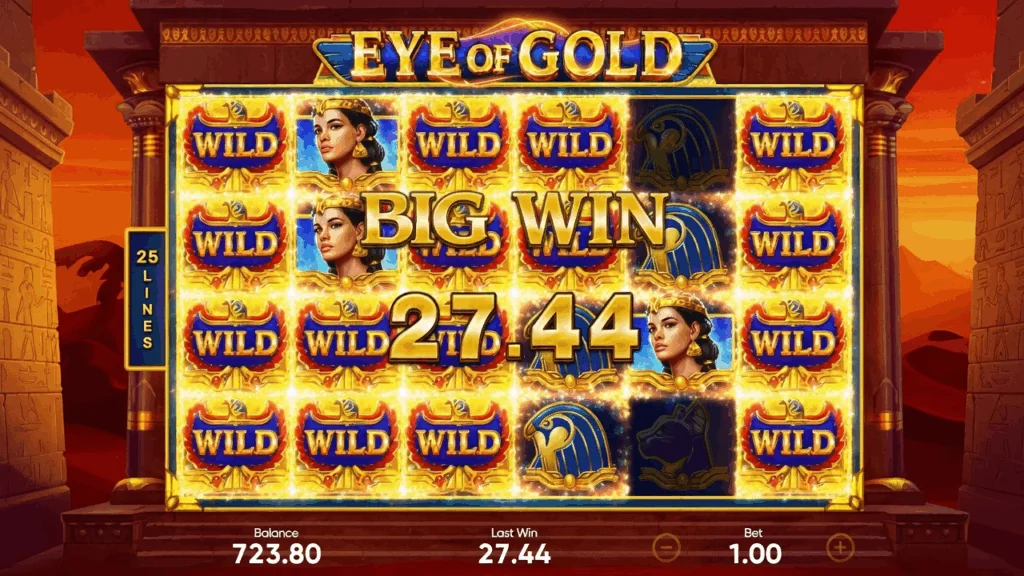
Eye of Gold is a video slot built around ancient Egyptian mythology, placing the all-seeing eye at the center of its mechanical identity. The game runs on a 6-reel grid with 25 paylines, keeping the structure familiar enough not to impose a learning curve while leaving room for its bonus mechanics to carry the experience.
The RTP sits at 95.69% – a figure that lands comfortably above the industry median for this volatility class. Volatility is rated high, which directly shapes how sessions behave: dry streaks are real and sometimes extended, but when the game breaks open, payouts tend to cluster rather than trickle. That asymmetry is the defining mathematical trait of the Eye of Gold slot.
The maximum win is capped at 1,800x the bet, which positions this title in the upper-mid range of high-volatility slots – ambitious enough to attract variance seekers, but not the kind of ceiling that distorts bankroll planning into fantasy territory. Bets scale from €0.20 to €100 per spin, covering a wide spread of player profiles without forcing minimum stakes that feel punishing or maximums that feel out of reach.
The game was developed by Booongo, a studio with a consistent release cadence and a well-documented approach to volatility calibration. Within their catalog, Eye of Gold occupies a specific niche: it targets players who want Egyptian theming with a mechanical emphasis on free spin accumulation rather than instant base-game multipliers.
Easy, Fast, Comfortable
The interface loads cleanly across desktop environments, with the main control panel anchored to the bottom of the screen in a layout that prioritizes spin access over feature discovery. The bet adjustment slider responds immediately, and there is no unnecessary confirmation step between stake changes and the next spin – a small detail that compounds positively over longer sessions.
Autoplay is present and configurable. Players can set loss limits, single-win limits, and spin counts independently, which makes it genuinely useful rather than decorative. The quick-spin toggle cuts animation time noticeably without removing the visual feedback needed to track symbol outcomes.
The paytable is accessible from a single tap or click, structured in a scrollable format that doesn’t require navigating away from the game screen. Information density is appropriate – enough to understand what each symbol pays without needing a spreadsheet to decode the logic. For players testing the Eye of Gold demo before committing real stakes, this transparency in the UI reduces the friction of orientation considerably.
One functional aspect worth noting: the game does not require account registration to access in demo mode on most platforms. The free play version runs identically to the real-money build in terms of mechanics and speed – no artificial delays, no feature suppression.
Game Design
Theme and Graphics
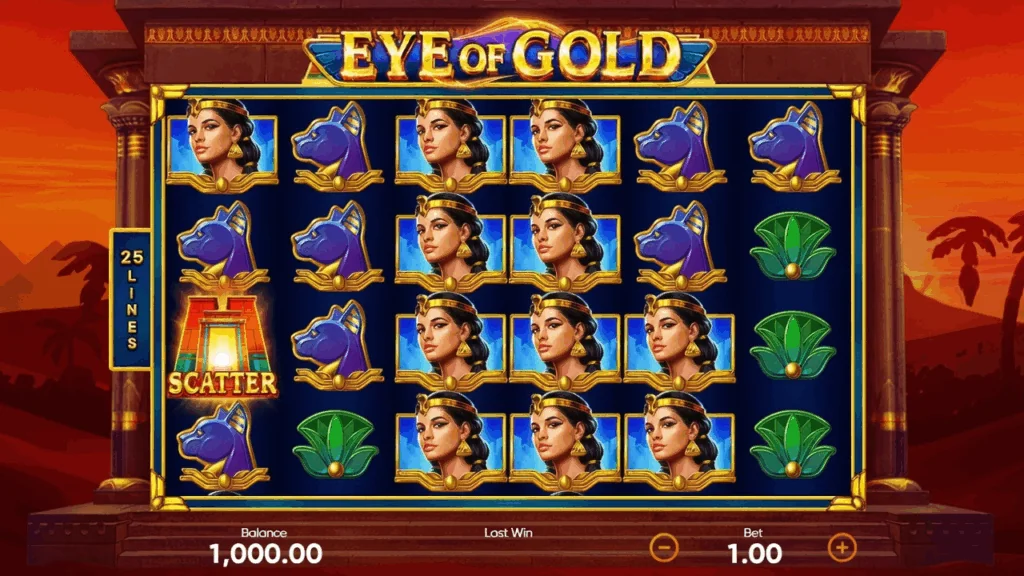
The visual language draws from a curated version of Egyptian iconography – not the exhaustive catalog approach some games use, but a focused selection: the Eye of Horus, scarab beetles, the ankh, pharaonic portraits, and hieroglyph-adjacent geometric symbols. The color palette is built around deep gold tones, rich navy blues, and amber, creating contrast that keeps symbol clarity intact even when multiple reels are active simultaneously.
Symbol design leans toward relief-style illustration rather than flat digital art. There is a sense of dimensional weight to the higher-value icons that distinguishes them from the lower-paying card-rank substitutes still present in the paytable. The background depicts a temple interior with subtle light rays and sandstone texture – atmospheric without being distracting.
Animation quality during standard play is measured and deliberate. Winning combinations trigger a brief highlight pulse rather than a full-screen spectacle, keeping the pace of play intact. The visual complexity scales up meaningfully during bonus triggers, where the presentation shifts register without feeling grafted on.
Sounds and Gameplay Experience
The audio design operates in two distinct modes. During base game play, the soundtrack maintains a low-key, rhythmic underscore – present enough to establish atmosphere, quiet enough not to demand attention. Percussion patterns follow an approximation of traditional instrumentation rather than generic “Egyptian music” clichés, which gives the ambient layer a slightly more considered feel.
Bonus triggers are accompanied by a deliberate escalation in both tempo and tonal register. The transition is clean rather than jarring, which matters in high-volatility play where that moment of escalation arrives infrequently and needs to land with some weight.
Sound effects tied to individual symbol landings are distinct without being cluttered. Winning spins carry satisfying audio feedback proportional to their value – small wins receive understated acknowledgment while larger combinations trigger a more pronounced response. The overall mix avoids the trap of constant audio saturation that makes many Egyptian-themed slots feel interchangeable.
Bonuses and Symbols
Symbols in the Game
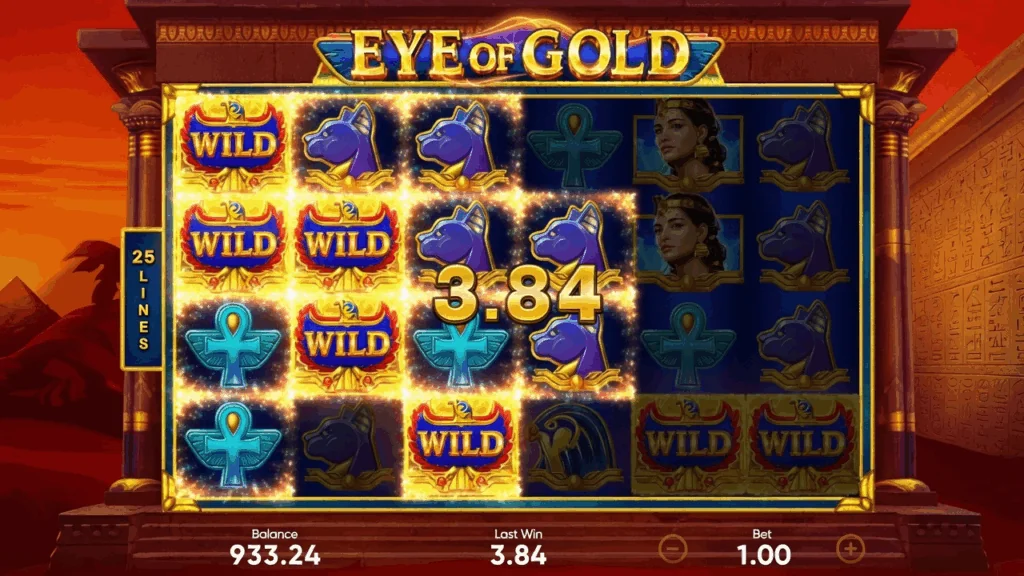
The Eye of Gold symbols divide into two functional tiers. The premium tier consists of four thematic icons: the Eye of Horus (highest-paying), a pharaoh’s portrait, a scarab, and an ankh cross. These symbols form the backbone of meaningful base-game wins and are the primary targets during free spin sequences.
The lower tier uses stylized card ranks – A, K, Q, J, 10 – rendered in the game’s gold-and-blue palette. They contribute to winning combinations frequently but at payout values that serve bankroll maintenance rather than growth during extended sessions.
The Wild symbol substitutes for all paying symbols and appears exclusively on the middle three reels in the base game. This reel restriction is deliberate – it prevents wild-driven wins from becoming a base-game mechanic and funnels their full utility into the bonus round, where their reel coverage expands.
The Scatter symbol, represented by the golden eye motif, triggers the free spin feature and holds no substitution function. Its role is singular: accumulate three or more across any reel positions and initiate the bonus sequence.
Bonus Rounds and Free Spins
Three scatter symbols trigger 10 free spins. Four award 15, and five scatters – a relatively rare event given their distribution – deliver 20 free spins. The bonus round can be retriggered within itself under the same scatter accumulation rules, with no hard cap on the number of retriggers in a single session.
The structural shift inside the free spin round is where Eye of Gold gameplay separates itself from base-game behavior. Wild symbols, which were confined to reels 2, 3, and 4 during standard play, now operate across all six reels. This expansion meaningfully alters the probability distribution of high-value combinations and explains why the majority of the slot’s max win potential is concentrated in this phase.
There are no multiplier wilds or cascading mechanics layered on top – the design philosophy here is additive volume over complexity. More spins, expanded wild coverage, retrigger potential. The simplicity of the structure makes it easy to track what is happening, which is a practical advantage in a high-volatility context where attention to spin outcomes actually matters.
Paytable and Winning Combinations
The Eye of Gold paytable requires five matching symbols to reach peak payouts for premium icons. Five Eye of Horus symbols return 500x the bet, which is substantial at the bet ceiling but reflects the frequency at which that combination realistically appears. Four-of-a-kind combinations return 100x for the same symbol – a meaningful step down that reinforces how pay concentration works in this game.
The pharaoh symbol returns 300x for five, 75x for four, and 25x for three. The scarab and ankh follow a similar descending curve. Lower-paying card symbols cap at 125x for five-of-a-kind on the Ace, dropping sharply for three-of-a-kind combinations across the board.
Paylines pay left-to-right from reel one. Scatter payouts are independent of payline direction – three scatters anywhere trigger the feature regardless of position. There is no pay-both-ways mechanic; the structure is strictly directional, which concentrates win weight on symbol sequences that begin from the leftmost reel.
Jackpot
Eye of Gold does not include a progressive jackpot. The maximum win of 1,800x the stake is a fixed theoretical ceiling built into the game’s volatility and RTP model, not a prize pool that accumulates across player activity. This distinction matters for players accustomed to jackpot-hunting mechanics – the game’s ceiling is predictable and stable rather than variable and externally driven.
The 1,800x cap is reachable through a combination of high-value symbol clusters during a retrigger-extended free spin sequence with expanded wild coverage. It is not a marketing abstraction – the mathematical path to that figure exists within the documented mechanics – but it represents an outlier outcome rather than a repeatable benchmark.
Mobile Device Compatibility
Eye of Gold runs on HTML5, meaning no separate application is required and no platform-specific version exists. The game detects screen orientation and adjusts the layout accordingly – portrait mode on mobile compresses the control panel beneath the grid while keeping it fully functional, and landscape orientation replicates the desktop experience with minimal scaling compromise.
Touch input is responsive across tested device categories. Swipe-based bet adjustment works as expected, and the spin button is sized and positioned to avoid accidental activation during scrolling. Autoplay configuration is accessible through the same menu path as desktop without interface reduction.
Performance on mid-range smartphones from the past three years shows no frame rate degradation during bonus sequences. The animation load during free spin retriggers – the visually densest moment in the game – remains stable. Battery draw is consistent with comparable HTML5 titles of this complexity level.
Advantages and Disadvantages
Advantages
The RTP of 95.69% is verifiably above average for high-volatility slots in the Egyptian theme category, where operators frequently deploy lower-RTP versions of popular titles. The published figure applies to the standard game configuration.
Wild expansion during free spins is a mechanically sound feature – it concentrates variance in the bonus phase without requiring players to track stacking multipliers or complex modifier sequences. The learning curve flattens quickly.
The retrigger system has no cap, which means the theoretical ceiling of 1,800x is not a pure luck artifact – extended bonus sequences created through retriggers provide a structural path to larger accumulations. This distinguishes the game from fixed-round bonus formats where the ceiling is hard and immovable regardless of in-round outcomes.
Demo mode availability without registration removes the barrier to understanding the game’s rhythm before financial commitment. For high-volatility titles specifically, experiencing the pacing of dry spells and bonus frequency is genuinely useful pre-commitment information.
Limitations
High volatility means the base game can run for extended periods without delivering payouts that offset the bet rate. Players who need regular reinforcement to sustain engagement will find the long intervals between bonus triggers actively uncomfortable rather than suspenseful.
The absence of any base-game multiplier or modifier feature means sessions spent outside the free spin round carry limited strategic interest. There is nothing to build toward incrementally – the experience bifurcates sharply between routine spins and the bonus round.
The 1,800x maximum win, while respectable, is lower than several competing high-volatility titles in the same RTP bracket. Players specifically chasing theoretical ceiling figures will find higher caps available elsewhere in the market without sacrificing significant RTP.
Wild symbols are restricted to reels 2-4 in the base game. This design choice, while intentional, reduces base-game win frequency in a way that some players will experience as mechanical tightness rather than anticipation-building tension.
Conclusion
Eye of Gold delivers on a specific promise: high-volatility play with a coherent structural logic. The RTP of 95.69% provides a mathematically sound foundation, the free spin mechanics are transparent and effective, and the wild expansion mechanic gives the bonus round a distinct identity rather than functioning as a slightly faster version of the base game.
Where the game makes trade-offs, they are consistent. The base game is sparse by design, not by oversight. The max win cap reflects a volatility model calibrated for realistic session variance rather than extreme tail outcomes. The Egyptian theme is executed with enough visual care to avoid the generic, without attempting to redefine the aesthetic category.
For players evaluating the Eye of Gold demo as a pre-commitment tool, it accurately represents the live game. For players assessing it against alternatives: this is a slot that rewards patience with the volatility profile and punishes those who expect regular base-game returns. That trade-off is clearly communicated in every mechanical and mathematical layer of the game’s design.