Eye of Horus fortune play Slot Demo – Honest Review, RTP & Volatility
Game Overview and Basic Information
Blueprint Gaming built Eye of Horus Fortune Play as a direct evolution of the original Eye of Horus framework – not a reskin, but a structural expansion. The Fortune Play mechanic is the defining addition: it gives players optional access to a guaranteed bonus round entry at a fixed cost, bypassing the standard trigger process entirely. That single change shifts how bankroll decisions work at a fundamental level.
The slot runs on a 5×3 reel grid with 10 fixed paylines. RTP sits at 94.95% in the standard configuration, though this climbs slightly depending on the active Fortune Play mode. Volatility is classified as high, which aligns with the game’s payout structure – wins cluster around the free spins phase rather than distributing evenly across base play.
Max win potential reaches 50,000× the stake, achieved through stacked wilds and multiplier-linked free spins. This ceiling is realistic within the game’s mathematical model but requires a favorable free spins configuration to approach. Base game wins alone will not reach it.
The game targets experienced slot players who understand variance management. It is not built for passive entertainment – the Fortune Play purchase system demands active decision-making about when to invoke it.
Easy, Fast, Comfortable
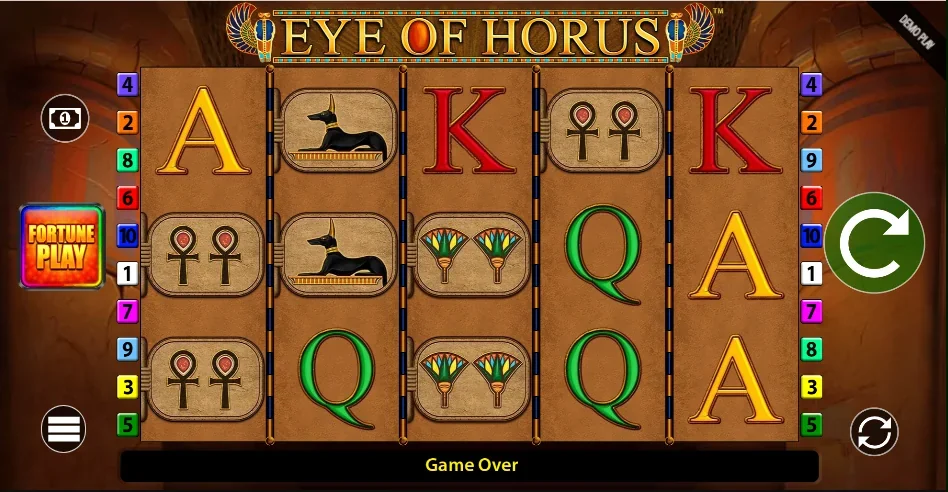
Blueprint’s interface on this title is deliberately minimal. The control panel holds spin, autoplay, bet adjustment, and a direct Fortune Play activation button – nothing is buried in sub-menus. Bet levels step in clean increments, and the Fortune Play cost displays dynamically based on the current stake, so there’s no need for manual calculation.
Load times in demo mode are fast across desktop and browser environments. The autoplay function includes loss limit and single win limit options, which is practically useful for players testing volatility patterns before committing real funds.
The free play version replicates all mechanics identically to the real-money build. Fortune Play mode activates in demo just as it would in a live session – full feature access with no functional restrictions. This makes it a reliable tool for understanding exactly how the bonus purchase behaves before using actual deposits.
Paytable access sits within a single tap, and the layout is clear without being simplified to the point of losing detail. Winning line indicators appear cleanly on-screen post-spin without cluttering the reel area.
Game Design
Theme and Graphics
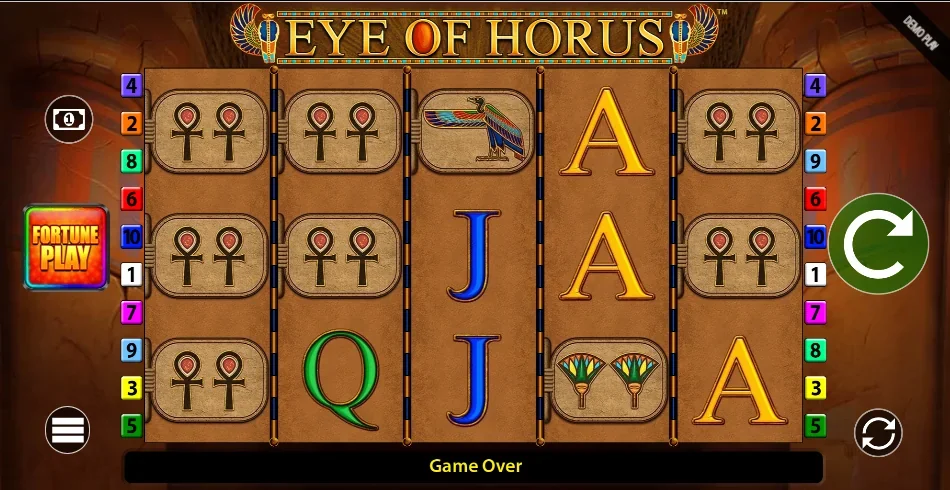
The Egyptian mythology framing here draws specifically from Horus iconography rather than the broader Pharaoh aesthetic common to the genre. The Eye of Horus symbol is treated as a genuine visual centerpiece – stylized with gold and lapis lazuli color treatment that feels deliberate rather than decorative. Background artwork depicts layered temple architecture with ambient depth that doesn’t compete with the reels for attention.
Symbol rendering is crisp at high resolution, with distinct silhouettes for each tier. The contrast between premium and standard symbols is immediately readable – there’s no visual ambiguity about what landed on a payline. Blueprint avoided the over-saturated palette that makes many Egyptian-themed slots feel interchangeable; the color temperature here is warmer and more grounded.
Animation quality is restrained. Winning symbols pulse and highlight rather than triggering full-screen sequences, which keeps the session pace controlled rather than constantly interrupted by presentation effects.
Sounds and Gameplay Experience
The audio design follows the visual restraint. Base game music sits at a low-tension ambient register – present but not intrusive. The moment free spins trigger or Fortune Play activates, the soundtrack shifts register significantly, creating genuine audio contrast that reinforces the mechanical shift without feeling manufactured.
Reel stop sounds have weight. Individual symbol land audio is differentiated enough that experienced players can begin reading spin results aurally before the visual highlight completes. This is a small detail that Blueprint executes well and that many competing titles ignore entirely.
The immersive quality during free spins is notably stronger than in the base game. Extended free spin sequences with stacked wilds building across multiple reels create accumulated tension that the audio layer supports effectively. Sessions with multiple re-triggers feel meaningfully different from single-feature rounds.
Bonuses and Symbols
Symbols in the Game
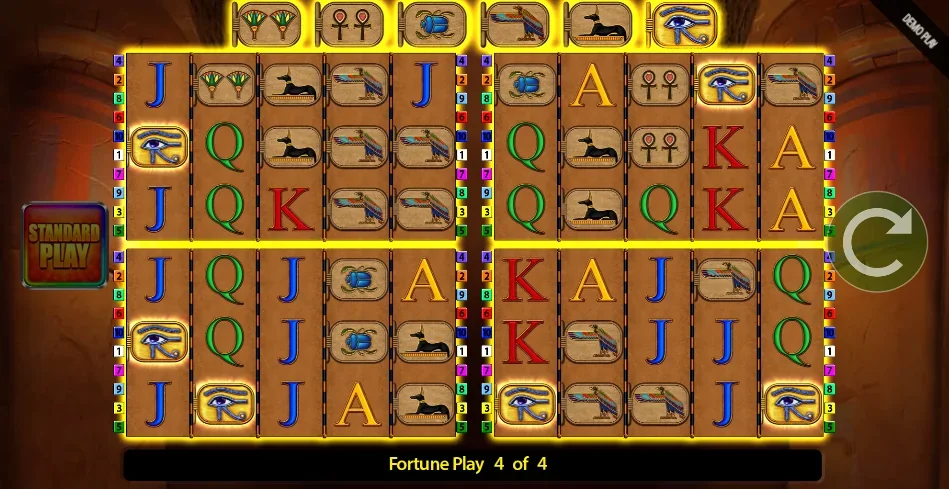
The premium symbol set consists of four Egyptian deity figures – Horus, Anubis, Ra, and Bastet – each carrying distinct multiplier values across payline lengths. Horus functions as the top-paying standard symbol. The Eye of Horus itself operates as a scatter, triggering free spins and acting as the centerpiece of the Fortune Play mechanic.
Wild symbols appear as golden cartouche designs and substitute for all standard symbols except the scatter. Critically, wilds can appear stacked on multiple reels simultaneously during free spins – this stacking behavior is where the game’s high-win potential actually originates.
Low-value symbols use card rank imagery (A, K, Q, J, 10) styled within the Egyptian aesthetic. They fill paylines frequently in base play but contribute minimally to significant win events. Their primary function is bankroll pacing rather than meaningful payout generation.
Bonus Rounds and Free Spins
Three scatter symbols landing anywhere on the reels award 8 free spins. The Fortune Play system offers an alternative path: at a cost of roughly 100× the current stake, players can purchase immediate bonus round entry. A second Fortune Play tier exists that guarantees entry with enhanced starting conditions – this costs more but reduces variance around the free spins outcome distribution.
During free spins, stacked wilds appear on reels 2, 3, 4, and 5. When a wild reel appears, the entire reel locks as wild for all remaining spins in the sequence. Multiple locked wild reels compounding within a single free spins round is the primary mechanism behind large win events. Re-triggers extend the sequence, maintaining any already-locked wild reels – meaning late re-triggers carry significantly higher expected value than early ones.
The Fortune Play mechanic does not change the free spins structure itself – it changes access probability and timing. Players who use it are buying certainty of entry, not enhanced feature parameters (unless using the premium Fortune Play tier).
Paytable and Winning Combinations
Payouts scale sharply between the premium and standard symbol tiers. Five Horus symbols on a payline pays 25× the stake – the highest fixed symbol return in the base game. Five of any card-rank symbol returns between 0.5× and 1× the stake, confirming their role as filler rather than win contributors.
The differential between a base game Horus five-of-a-kind and a free spins round with three or four locked wild reels is enormous – the latter can produce returns exceeding 500× in a single spin when the remaining symbol distribution aligns. That gap defines the volatility experience: long base game sequences punctuated by infrequent but disproportionate feature payouts.
Paylines pay left-to-right from reel 1. No pay-both-ways or cluster mechanic applies – all combinations must begin at the leftmost reel. Partial line wins (three or four of a kind) occur regularly and maintain session balance during extended base game play.
Jackpot
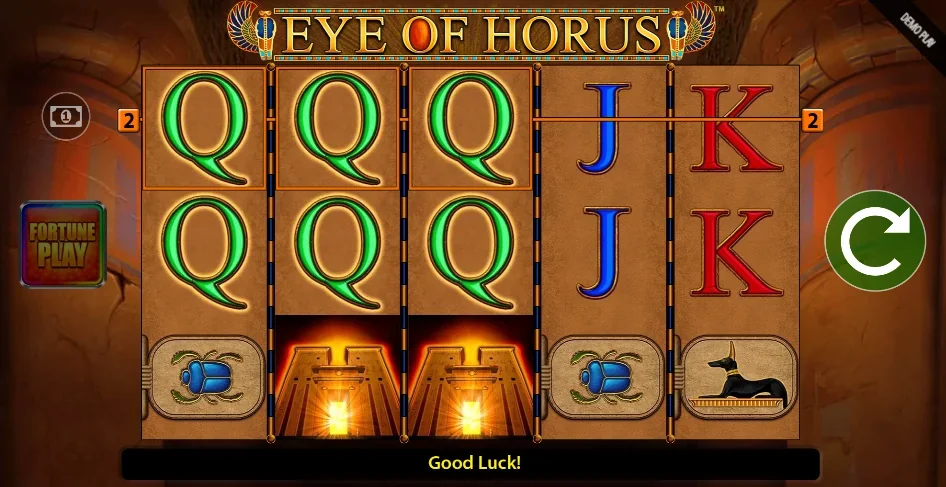
Eye of Horus Fortune Play does not include a progressive jackpot system. The 50,000× max win represents a fixed mathematical ceiling defined by the RNG model – it is achievable through symbol combination and wild lock accumulation within the free spins phase, not through a separate jackpot trigger. Players seeking network-linked or site-wide jackpot structures will not find that here. The game’s reward architecture is entirely contained within its own volatility parameters.
Mobile Device Compatibility
The game was built on a framework that scales cleanly to portrait and landscape orientations without interface compromise. On mobile, the Fortune Play button remains prominently accessible rather than being deprioritized as happens on some desktop-first designs when adapted for smaller screens.
Touch input response is accurate, with no observable lag between tap and spin initiation. Autoplay configuration remains fully functional on mobile – all limit options present on desktop carry over without reduction. The reel grid scales proportionally; no visual elements are cropped or obscured at standard smartphone screen ratios.
Performance consistency across mid-range Android devices and current iOS builds is solid. Frame rate during free spins animation sequences does not degrade noticeably on hardware that’s two to three years old. Connectivity interruption handling returns to the last verified game state without loss of in-progress free spins – a basic but important protection for mobile sessions on variable connections.
Advantages and Disadvantages
Advantages
The Fortune Play mechanic solves a specific and legitimate problem: high-volatility slots with low free spins trigger frequency can produce extremely long base game stretches without reaching the feature. The bonus purchase option converts that unpredictability into a direct decision – players who understand the math can assess whether the current bankroll position justifies paying 100× stake for guaranteed entry versus waiting for a natural trigger.
Stacked wild mechanics during free spins create genuine variance within the bonus round itself. Not all activations are equivalent – the wild lock accumulation system means outcomes range from modest to exceptional depending on how the sequence develops, which maintains interest across repeated feature entries.
RTP at 94.95% is competitive within the licensed UK and European market segments where this game primarily operates. The demo availability with full Fortune Play functionality is practically significant – it allows real assessment of the purchase mechanic without financial exposure.
Limitations
The base game is financially unproductive by design. Extended sessions without triggering free spins – or without purchasing Fortune Play – will consistently erode bankroll. For players who find value in base game hit frequency, this slot delivers very little of it. The standard symbol payouts do not compensate for the gaps between feature entries at typical stake levels.
Fortune Play’s cost at 100× stake is accessible at lower bet sizes but becomes a meaningful commitment at mid-to-high stakes. Players who cannot or prefer not to use the purchase option are left with a high-volatility base game and a trigger rate that Blueprint does not publicly disclose with precision.
The Egyptian theme, while executed competently, occupies an extremely crowded space. Visually and conceptually, differentiation from other Horus-branded titles requires active attention to notice. The game’s identity rests almost entirely on the Fortune Play system rather than anything specific to its aesthetic.
Conclusion
Eye of Horus Fortune Play is a high-volatility slot built around a single mechanical idea executed well. The Fortune Play bonus purchase system is not a cosmetic addition – it materially changes how session strategy operates, and the RTP structure reflects that the feature is the primary value delivery mechanism. Players who engage with it as a passive spin-and-watch experience will find the base game thin. Players who treat the Fortune Play decision as a tactical variable will find more to work with.
The free demo provides complete access to that tactical layer. Testing multiple Fortune Play entries across different stake levels in demo before transitioning to real-money play is a practical approach – the feature behavior in demo is mechanically identical to live sessions, making it genuinely useful rather than just a preview tool.
At 94.95% RTP with a 50,000× max win ceiling and documented high volatility, the game occupies a specific position: it is built for players who accept infrequent wins in exchange for disproportionate return potential during feature phases. Whether that exchange suits a given player depends entirely on their risk tolerance and bankroll management approach – not on the game’s visual appeal or theme execution.