Eye of Horus megaways Slot Demo – Honest Review, RTP & Volatility
Game Overview and Basic Information
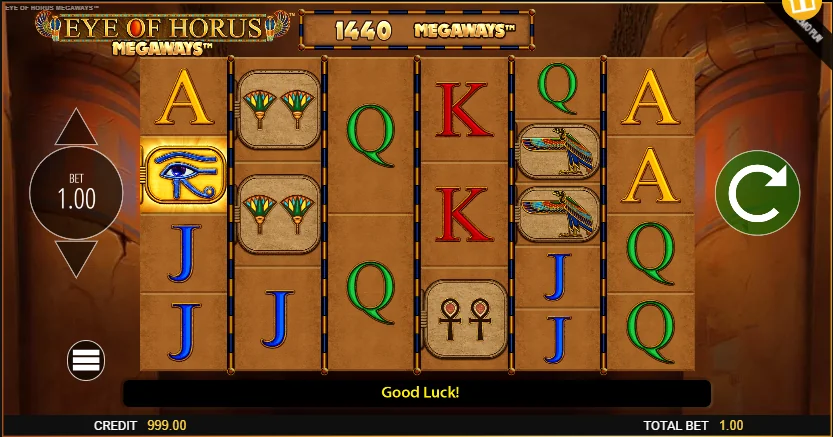
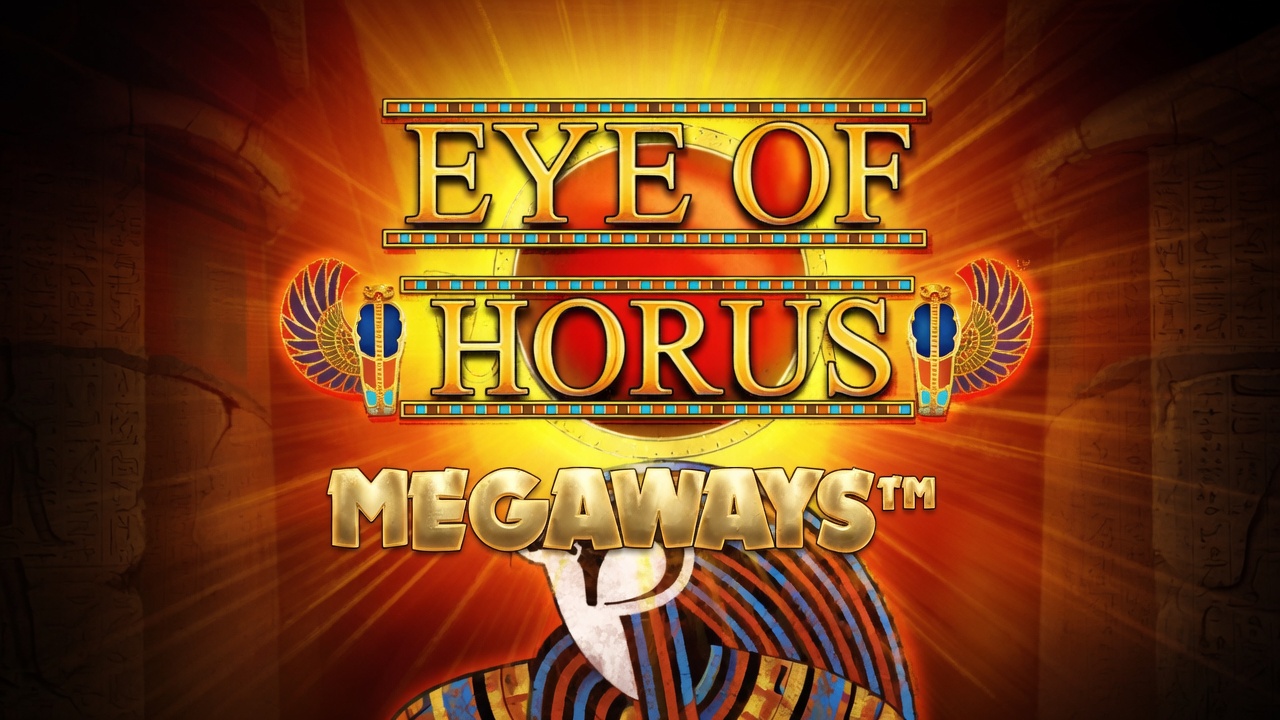
Blueprint Gaming took their already-established Eye of Horus franchise and rebuilt it on the Megaways engine licensed from Big Time Gaming – a decision that fundamentally changes how the game behaves mathematically and structurally. The result is a slot where the number of active ways to win shifts with every spin, reaching up to 15,625 combinations when all six reels expand to their maximum symbol count.
The Eye of Horus Megaways slot operates on a six-reel grid with an additional horizontal reel positioned at the top. Each main reel can display between two and five symbols per spin, while the top reel contributes a single symbol that cascades across all positions simultaneously. This mechanic – known as the Megaways system – means no two spins produce identical reel configurations.
RTP sits at 95.49% in its default configuration, though some casino operators deploy a lower-volatility version calibrated at 95%. Always verify which variant is active before committing real funds. Volatility is classified as high, with win distribution heavily skewed toward larger, less frequent payouts rather than consistent smaller returns.
The Eye of Horus Megaways max win is capped at 10,000x the total stake – a ceiling reached only through optimal free spin sequences with maximum multiplier stacking. Blueprint Gaming released the title in 2020, and it remains one of the more technically dense entries in the Megaways catalog, incorporating both Unlimited Win Multipliers and a Symbol Lock mechanic that distinguishes it from standard Megaways clones.
Easy, Fast, Comfortable
Launching the Eye of Horus Megaways demo requires no registration at most casino platforms – the game loads directly in-browser without software installation. The interface uses a bottom-anchored control panel that keeps spin controls, bet adjustments, and autoplay settings within thumb reach on any screen size.
Bet configuration covers a wide range. Stakes typically run from £0.10 to £10 per spin, making the game accessible to players managing tight session bankrolls and those comfortable with mid-range stakes. The autoplay function allows up to 100 spins with optional stop conditions including loss limits and single-win thresholds – a practical tool for evaluating the game’s variance pattern without manual intervention.
Navigation between the paytable, game rules, and active reel doesn’t interrupt session flow. The settings menu separates sound controls, game speed options (including a turbo spin mode that cuts animation time significantly), and display brightness adjustments. Turbo mode matters more than it might initially seem in a high-volatility slot – extended dry runs feel less punishing when each spin resolves in under a second.
The free play version mirrors the real-money build exactly in terms of mechanics and interface. The only functional difference is the use of virtual credits rather than deposited funds. This makes the demo genuinely useful for testing stake-to-bankroll management approaches before committing actual money.
Game Design
Theme and Graphics
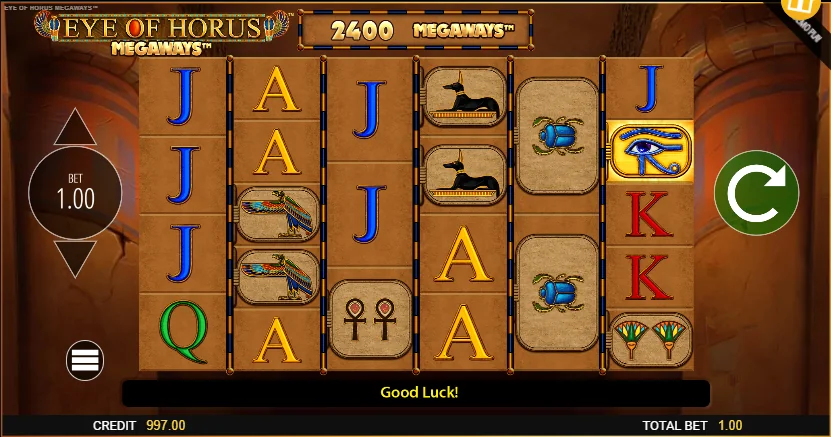
Blueprint Gaming anchored the visual identity in ancient Egyptian iconography, but avoided the flat, generic approach common to most Egypt-themed slots. The background renders a stylized temple interior with layered depth – columns recede into shadow, and gold-toned architectural details catch simulated light sources that shift subtly during base gameplay.
Symbol artwork is sharp and detailed at standard resolutions, maintaining clarity even when the grid expands to its maximum symbol count. The Megaways engine’s dynamic reel sizing could easily produce visual clutter, but Blueprint’s UI team handled the scaling well – larger reels don’t compress adjacent symbol art. High-value symbols use metallic rendering with amber and turquoise color accents that read clearly against the darker background palette.
The overall aesthetic sits closer to illustrated graphic design than photorealistic rendering. This is a deliberate choice – it holds up better at smaller screen sizes and avoids the uncanny quality that plagues slots trying to push hyper-realistic Egyptian imagery. The Eye of Horus symbol itself, the game’s central visual motif, appears consistently across the reels in multiple forms and never feels visually inconsistent with the broader design language.
Sounds and Gameplay Experience
The audio design follows a layered structure that responds to gameplay state. During base game spins, the soundtrack maintains a low-tempo ambient loop – present enough to establish atmosphere, restrained enough to avoid fatigue during extended sessions. When the Megaways count climbs toward higher values or a bonus trigger approaches, percussion intensity increases incrementally rather than jumping to a full crescendo without warning.
Free spins trigger a separate audio track with more prominent instrumentation – a legitimate compositional shift rather than a volume increase applied to the same loop. Landing winning combinations produces distinct audio cues that help players track cascade sequences without fixating on the screen. The sound design functions practically, not just decoratively.
Gameplay pacing feels slightly different from other high-volatility Megaways titles because of how the cascade system interacts with win multipliers. Each successive cascade within a single spin raises the multiplier, and the audio responds to each step – building anticipation in a way that makes cascade chains feel genuinely eventful rather than mechanical.
Bonuses and Symbols
Symbols in the Game
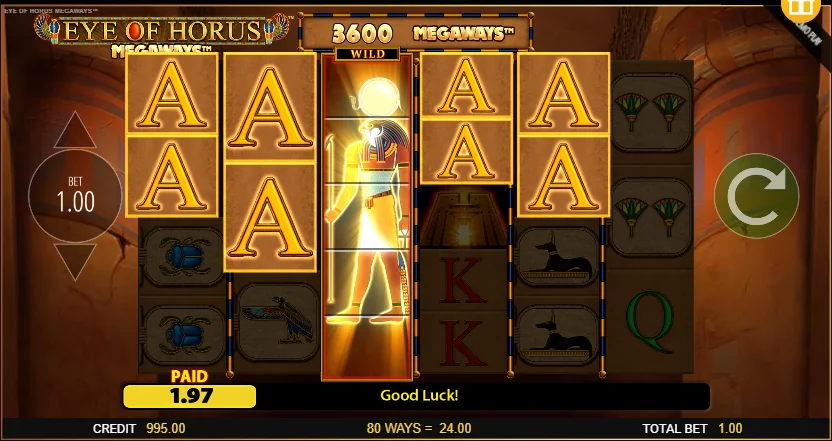
The Eye of Horus Megaways symbol set divides into two functional tiers. Low-value symbols use standard playing card ranks – 10 through Ace – styled with Egyptian detailing. These appear frequently and form the bulk of non-winning combinations during base gameplay.
High-value symbols represent Egyptian deities and artifacts: Horus, Anubis, the Scarab Beetle, and the Eye of Horus itself. Each carries distinct pay values, with the Eye of Horus symbol paying the highest amounts for matched sequences. The Wild symbol substitutes for all paying symbols except the Scatter and Lock symbols – a standard substitution function, but one that becomes significantly more valuable during multiplier-active free spins.
The Scatter symbol – depicted as a golden pyramid – triggers the free spins feature. Lock symbols, when they appear, hold specific symbols in place across subsequent spins, a mechanic that intersects with the free spins feature in ways that materially affect potential outcome distributions.
Bonus Rounds and Free Spins
Landing three or more Scatter symbols anywhere on the reels triggers the free spins round. Three Scatters award 8 free spins, four award 12, five award 16, and six award 20. Additional Scatters landing during free spins extend the round rather than retriggering it – each additional Scatter contributes extra spins to the remaining count.
The Unlimited Win Multiplier activates at the start of free spins at 1x and increases by 1 with every cascade within a single spin. The multiplier does not reset between free spins – it carries over throughout the entire bonus round. This accumulation mechanic is the primary driver of the 10,000x max win potential, as late-sequence cascades can occur with multipliers already at 20x, 30x, or higher from previous spins.
The Symbol Lock feature, operational during free spins, pins specific high-value or Wild symbols to their reel positions for subsequent spins. This introduces a compounding effect – locked Wilds with a rising multiplier create the conditions where the game’s theoretical max win becomes at least mathematically plausible rather than purely nominal.
Paytable and Winning Combinations
Wins require matching symbols on adjacent reels starting from the leftmost reel. The Megaways system means pay lines don’t exist in the traditional sense – any symbol combination appearing on consecutive reels from left to right constitutes a valid win, provided the symbols are identical.
High-value symbol payouts at maximum ways (six-of-a-kind): the Eye of Horus symbol pays approximately 50x stake, Horus and Anubis symbols pay in the 20-30x range, and the Scarab Beetle pays slightly below that tier. Low-value card symbols pay between 0.5x and 3x for six-of-a-kind combinations – functional contributions to cascade sequences rather than meaningful standalone wins.
The cascade mechanic (referred to as Tumble in some Blueprint documentation) removes winning symbols from the grid after each win and drops new symbols from above. New combinations formed by the replacement symbols generate additional wins within the same spin. This continues until no new winning combinations form, making multi-cascade spins the norm during free spins rather than the exception.
Jackpot
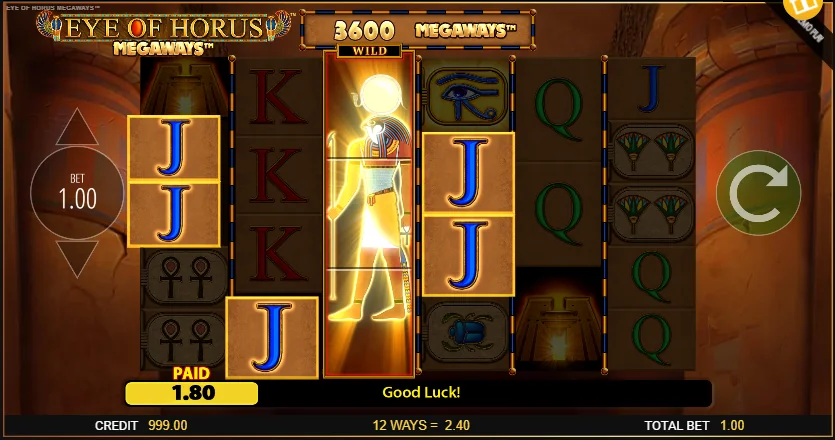
Eye of Horus Megaways does not feature a progressive jackpot or fixed jackpot tier structure. The 10,000x stake maximum win functions as a mathematical ceiling built into the game’s volatility model rather than a jackpot prize pool. Some Blueprint Gaming titles connect to the Blueprint Jackpot King network, but this game operates independently of that system. Players seeking network jackpot exposure should note this distinction before selecting the game for that purpose.
Mobile Device Compatibility
The game runs on HTML5 and performs consistently across iOS and Android without requiring dedicated app installation. Blueprint Gaming optimized the layout for portrait and landscape orientations – the grid and control panel reposition rather than simply scaling down, which preserves symbol legibility at smaller dimensions.
Load times on mobile connections vary by network condition, but the game’s asset size is managed efficiently enough that it doesn’t become a barrier on standard 4G connections. The turbo spin option is particularly practical on mobile, where extended sessions can create noticeable battery drain – faster spin resolution per session length helps mitigate this.
Touch controls map cleanly to all interactive elements. The bet adjustment slider, autoplay configuration, and paytable navigation all respond accurately to tap inputs. The game doesn’t require pinch-zooming to access any functional element – a baseline requirement that some competing titles still fail to meet consistently.
Advantages and Disadvantages
Advantages
The persistent multiplier during free spins is the game’s most structurally significant strength. Unlike Megaways titles that reset the multiplier with each new free spin, this one compounds across the entire bonus round – creating legitimate potential for multiplier values that actually affect the outcome meaningfully rather than topping out at modest levels.
The Symbol Lock mechanic adds a layer of mechanical depth that most Megaways titles lack. It creates scenarios where free spins become increasingly favorable as the round progresses, rather than each spin being statistically independent. This gives experienced players something specific to track and understand rather than pure variance watching.
RTP at 95.49% sits above the industry average for high-volatility Megaways games, which frequently hover at 95-96%. The demo version accurately replicates the full mechanics, making it genuinely useful for pre-deposit evaluation rather than a stripped-down preview.
Limitations
High volatility with a persistent multiplier model means base game sessions can extend through long losing sequences before a bonus trigger. Players with limited session bankrolls may exhaust their budget before reaching free spins – the game’s best features are locked behind a trigger frequency that doesn’t favor short sessions.
The 10,000x max win, while nominally substantial, requires a confluence of conditions – high multiplier accumulated early, Symbol Locks on high-value symbols, and cascade chains in the final free spins – that makes it a theoretical figure rather than a realistic session target. Some players may find the gap between the stated ceiling and practical outcomes frustrating over extended play.
The low-value card symbols appear at a frequency that dilutes cascade sequences in the base game. High reel counts generated by the Megaways system don’t consistently translate to high-quality symbol distributions, and the card ranks contribute minimally to meaningful win sequences despite occupying significant reel real estate.
Conclusion
Eye of Horus Megaways earns its position in Blueprint Gaming’s catalog through specific mechanical decisions rather than aesthetic novelty. The persistent multiplier and Symbol Lock combination create a free spins structure that distinguishes the game from generic Megaways implementations. RTP at 95.49% is defensible for the volatility level, and the demo accurately represents what real-money play delivers mechanically.
The game suits players who understand high-volatility mathematics and are comfortable with session variance that can run significantly negative before a meaningful bonus trigger. It’s not suited to short sessions, small bankrolls, or players prioritizing consistent return frequency over ceiling potential. Approached with appropriate stake management relative to session budget, it delivers the kind of bonus round depth that justifies its volatility profile.