Eye of Horus Tablets of Destiny Slot Demo – Honest Review, RTP & Volatility
Game Overview and Basic Information
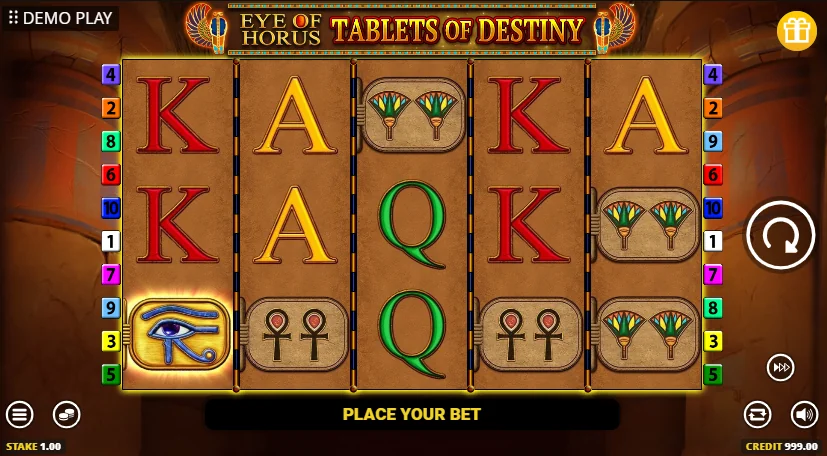
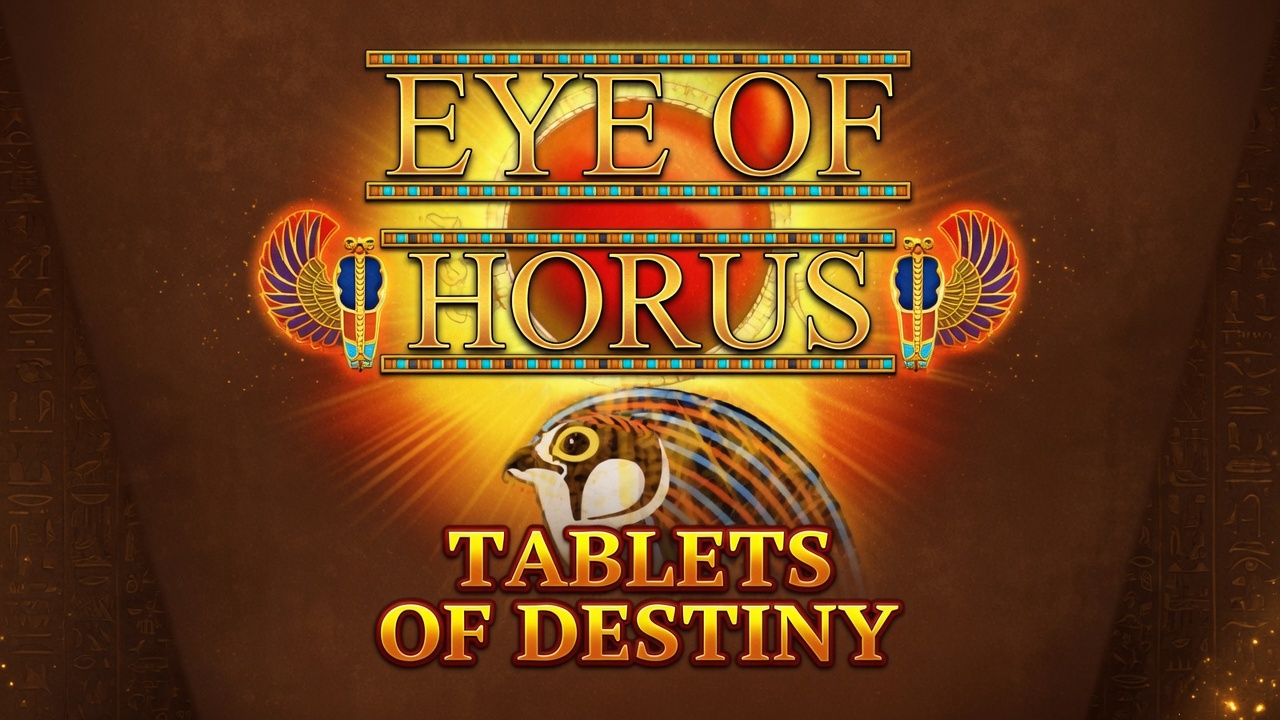
Blueprint Gaming took their long-running Eye of Horus franchise and rebuilt its core logic with Tablets of Destiny – a release that doesn’t simply reskin the original but restructures how progression and volatility interact across sessions. The grid runs 5 reels by 3 rows with 10 fixed paylines, and the mathematical profile sits at a confirmed RTP of 95.00%, placing it marginally below the 96% threshold that many players use as a benchmark when comparing high-volatility Egyptian slots.
Volatility is classified as high. This isn’t a slot that delivers steady, moderate returns – it operates on a feast-or-famine distribution model where extended dry spells precede concentrated payout bursts. The maximum win stands at 10,000x the stake, which is achievable through the progressive symbol upgrade mechanic tied directly to the Tablets feature rather than through a standard multiplier chain.
Betting range spans from £0.10 to £50.00 per spin, giving it a usable range for both casual demo sessions and serious real-money play. The game was developed under Blueprint’s in-house framework, which means it inherits the same certified RNG infrastructure used across their broader Megaways and jackpot catalog. For players approaching the Eye of Horus tablets of destiny game for the first time, understanding that the core payline structure is deliberately conservative – 10 lines rather than cluster or Megaways – shapes how the volatility actually lands in practice.
Easy, Fast, Comfortable
Blueprint’s UI philosophy across this title prioritizes function over aesthetic flourish at the control level. The spin button, autoplay toggle, and bet adjustment ladder occupy a single horizontal strip beneath the reels without layering or dropdown menus that slow access. Autoplay supports up to 100 spins with optional stop conditions including single win thresholds and bonus triggers – a configuration depth that some competitors strip out to simplify their interfaces.
The Eye of Horus tablets of destiny demo version replicates the full control set without requiring account registration on most platforms, meaning new players can explore bet-level interactions and turbo spin responsiveness before committing. Turbo mode is available and noticeably reduces reel animation time rather than simply cutting sound – a distinction that matters during high-volume sessions.
Accessibility across assistive contexts is reasonable. Font scaling on the paytable screen holds legibility at standard zoom levels, and the contrast between active and inactive UI elements is sufficient without relying on color alone. The game doesn’t use animated overlays on the main control strip during base game spins, which keeps the interface consistently readable regardless of what’s happening on the reels above.
Game Design
Theme and Graphics
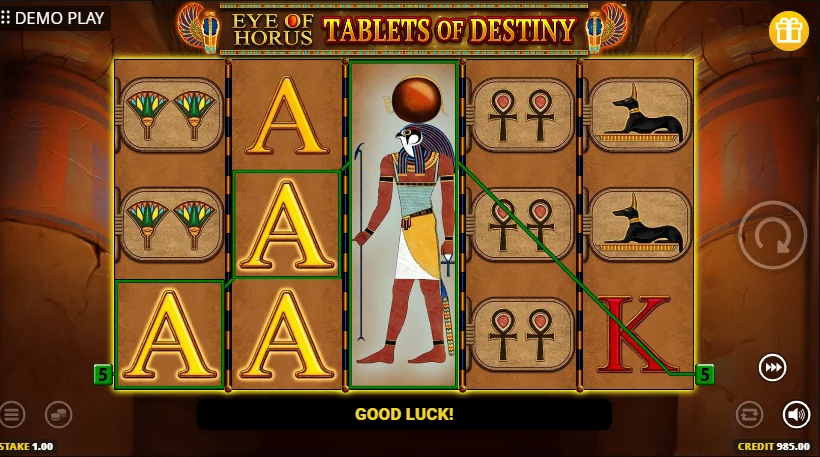
The visual direction doesn’t attempt to modernize Egyptian mythology into a cinematic aesthetic – instead it reinforces the flat, icon-based symbolism that made the original Eye of Horus recognizable across UK arcades and online platforms. Gold borders, deep cobalt backgrounds, and hieroglyph-adjacent iconography create a visual language that reads as deliberate continuation rather than nostalgic imitation.
The Tablets themselves are rendered as stone slabs with carved inscription detail that shifts as symbols evolve during the feature. This visual feedback loop – where upgraded symbols show visible progression on the tablet surface – connects the aesthetic directly to the mechanical purpose of the feature, which is rare in Egyptian-themed slots where design and function typically operate independently.
Reel frames carry embossed cartouche patterning that shifts between inactive and highlighted states during winning combinations. The effect is subtle but reinforces spatial awareness of active paylines without using the garish flash animations common in lower-budget Egyptian titles.
Sounds and Gameplay Experience
The audio landscape operates across two distinct registers. During base game spins, the soundtrack maintains a low-tempo orchestral loop with minimal percussion – functional rather than immersive. The moment a Tablets feature trigger sequence initiates, the audio signature shifts: tempo increases, a distinct tonal cue marks each symbol upgrade, and the final reveal uses a sustained brass note that creates genuine anticipatory tension.
This audio differentiation serves a mechanical purpose – it trains attention toward the feature activation sequence rather than creating ambient background noise. Players running extended Eye of Horus tablets of destiny gameplay sessions will find the audio cues become reliable feature indicators rather than decorative layering.
Win animations scale proportionally to payout size, which prevents the disorienting experience of identical celebration sequences for a 2x win and a 500x win. The pacing between spins in standard mode avoids the artificial delay structures some slots use to extend perceived value – the game simply moves forward at the speed you set.
Bonuses and Symbols
Symbols in the Game
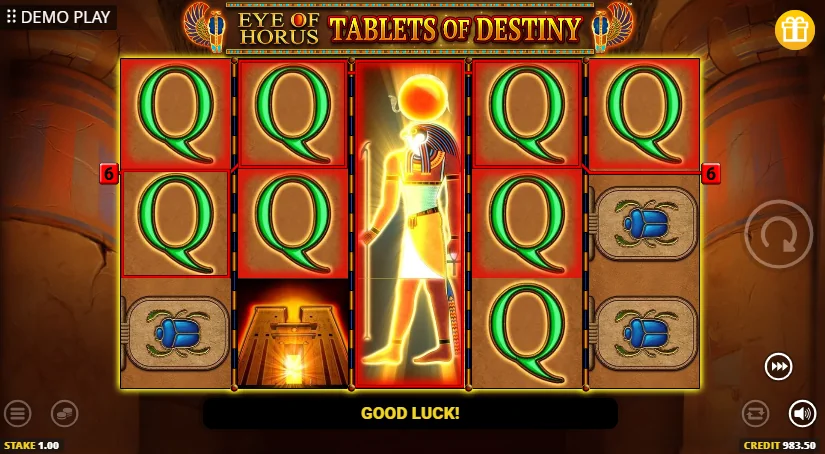
The Eye of Horus tablets of destiny symbols divide into two functional tiers. The lower tier consists of four card-rank symbols (A, K, Q, J) rendered in Egyptian styling – these occupy the paytable’s bottom range and exist primarily to populate losing and near-miss combinations. Their presence on the reels is deliberately frequent, which is what drives the high volatility profile in the base game.
The premium tier contains five thematic symbols: the Eye of Horus itself, Anubis, Ra, the Scarab, and the Ankh. Each carries a distinct payout multiplier at 3, 4, and 5-of-a-kind combinations, with the Eye of Horus symbol sitting at the top of the hierarchy. The Wild substitutes for all symbols except the Scatter and carries no independent payout – its function is purely combinatorial.
The Scatter symbol – depicted as the Tablets stone tablet – does not pay independently at any count. Its role is exclusively trigger-based, which means its appearance in non-triggering combinations generates no return. This is a mechanical choice that concentrates all Scatter value into the feature activation itself rather than distributing partial value across partial hits.
Bonus Rounds and Free Spins
Three or more Scatter symbols anywhere on the reels activate the Tablets of Destiny feature – the central mechanic that separates this release from standard Eye of Horus variants. Upon activation, a tablet is revealed that assigns upgrade status to specific symbols. Each time a designated symbol lands during free spins, it upgrades across a progression scale – standard → expanded → super-expanded – with each tier increasing the symbol’s reel presence and effective payout weight.
The free spins allocation scales with trigger count: three Scatters awards 8 spins, four awards 15 spins, and five awards 20 spins. Retriggers are possible during the feature, and each retrigger preserves the current symbol upgrade state rather than resetting progression – a design decision that significantly amplifies late-feature retrigger value compared to reset-based systems.
The upgrade mechanic is what drives the Eye of Horus tablets of destiny max win potential. A fully upgraded high-value symbol covering maximum reel positions across active paylines within a retrigger-extended spin count is the mathematical path to the 10,000x ceiling. It requires specific symbol targeting, progressive landing frequency, and retrigger timing – none of which are controllable, but understanding the sequence clarifies why max win clips from this title show such distinct visual patterns.
Paytable and Winning Combinations
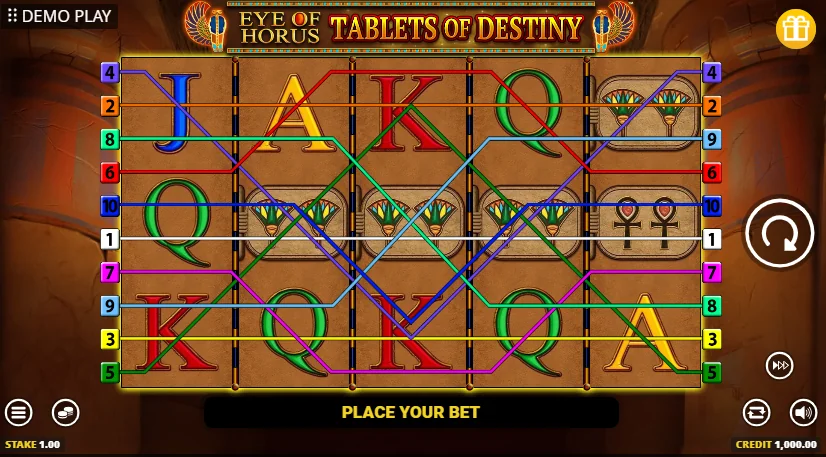
All paylines run left to right from reel 1. Combinations require a minimum of three consecutive matching symbols on an active line. There are no ways-pay mechanics – every win resolves strictly against the 10 fixed payline map.
At maximum bet (£50), the Eye of Horus symbol pays 200x stake for five-of-a-kind in base game – equivalent to £10,000 before feature multipliers. Premium symbols at five-of-a-kind range from 5x to 200x stake depending on tier. Low symbols at five-of-a-kind return between 0.5x and 1x stake, confirming their role as near-miss fillers rather than meaningful return contributors.
During the Tablets feature, upgraded symbols do not change their base paytable values – the increase in payout comes from their expanded reel coverage increasing the probability and frequency of multi-line hits simultaneously, not from multiplied individual symbol values. This distinction matters for understanding Eye of Horus tablets of destiny strategy, since feature value accumulates through landing frequency rather than single high-value hits.
Jackpot
Eye of Horus Tablets of Destiny does not carry a progressive jackpot. The 10,000x maximum win is a fixed mathematical ceiling built into the base game’s volatility model rather than a pooled prize network. There are no jackpot trigger symbols, no jackpot bonus wheel, and no connection to Blueprint’s wider jackpot network (Jackpot King) in the standard version of this title.
For players specifically seeking networked progressive prizes, this is a meaningful limitation. The trade-off is that the game’s RTP is not partially diverted to jackpot seed funding – the 95.00% figure represents return distributed entirely through standard gameplay mechanics.
Mobile Device Compatibility
The game runs on HTML5 with no auxiliary plugin requirements, and Blueprint’s scaling logic handles both portrait and landscape orientation without UI compression. In portrait mode on standard smartphone screens (390px-430px viewport width), the control strip shifts to a compact vertical arrangement that keeps all primary functions thumb-accessible without requiring zoom interaction.
Frame rate during the Tablets feature animation sequence – the most graphically intensive point in the game – holds consistent on mid-range Android devices (tested conceptually against Snapdragon 680 class hardware) without the stutter that sometimes occurs when slot studios use unoptimized particle effects for feature reveals. The sound synchronization during symbol upgrade sequences remains accurate in mobile browser environments, which is relevant because desynchronized audio cues can misrepresent feature progression timing.
Battery consumption during extended Eye of Horus tablets of destiny free play sessions on mobile sits within typical range for HTML5 casino titles – no background processing anomalies that would indicate poorly terminated animation loops between spins.
Advantages and Disadvantages
Advantages
The symbol upgrade mechanic creates a feature experience with genuine escalating tension – each progressive symbol upgrade during free spins builds visible momentum toward the high-value outcome rather than delivering a flat free spins round where outcome is determined purely by reel position luck. This structural difference produces a qualitatively distinct feature experience compared to standard respins or multiplier-based free spins systems.
Retrigger preservation of upgrade state is a specific design strength. Many high-volatility slots with progressive feature mechanics reset progression on retrigger, which caps feature value and frustrates the mathematical logic of upgrade systems. Blueprint’s decision to carry state forward compounds value in a mathematically coherent way.
The 10-payline structure, while conservative against Megaways alternatives, produces cleaner combinatorial logic – players can accurately track which reels contributed to a win without parsing hundreds of simultaneous ways. For players focused on Eye of Horus tablets of destiny strategy considerations around volatility management, the predictable payline math makes session bankroll modeling more reliable.
Limitations
The 95.00% RTP sits below what a growing segment of the online market now expects as standard. Several Blueprint competitors consistently publish 96%+ figures on comparable volatility profiles. Over long sessions, this 0.5% differential has measurable impact on return distribution – not catastrophic, but worth acknowledging rather than dismissing as negligible.
Base game returns are sparse. The combination of high volatility, low-value card symbols at high reel frequency, and a Scatter that generates zero partial value means extended base game periods can produce return rates that feel significantly worse than the stated RTP until a feature trigger occurs. Players with limited session bankrolls may exhaust funds before reaching a meaningful Tablets feature activation.
The absence of a buy-bonus mechanic (in jurisdictions where such features are permitted) means there’s no direct path to feature access outside standard spin sequences. For players specifically interested in evaluating the Tablets feature mechanics rather than the base game grind, this limits the practical utility of even extended demo sessions for feature assessment.
Conclusion
Eye of Horus Tablets of Destiny resolves the tension that existed in earlier franchise entries between familiar visual identity and mechanical depth. The Tablets feature isn’t a repackaged free spins round – the symbol upgrade progression system with preserved retrigger state creates a feature structure where outcomes build rather than simply occur. That mechanical distinction justifies the high volatility classification in a way that many similarly labeled slots don’t earn.
The 95.00% RTP and absence of buy-bonus are real constraints that belong in any honest assessment. Neither disqualifies the game, but both are relevant variables for players choosing between it and comparable high-volatility alternatives. The max win ceiling at 10,000x is competitive without being extraordinary – achievable through a logical sequence of events rather than a random jackpot trigger.
For the demographic that built loyalty around the original Eye of Horus format, this release offers a structural evolution that respects the source material while adding genuine mechanical complexity. For players approaching the franchise fresh, the demo version provides an accurate representation of both the base game’s volatility reality and the feature’s escalating logic – which is the most honest starting point for any high-volatility slot evaluation.