Goal Game Review by Spribe – RTP & Demo

Game Overview and Basic Information
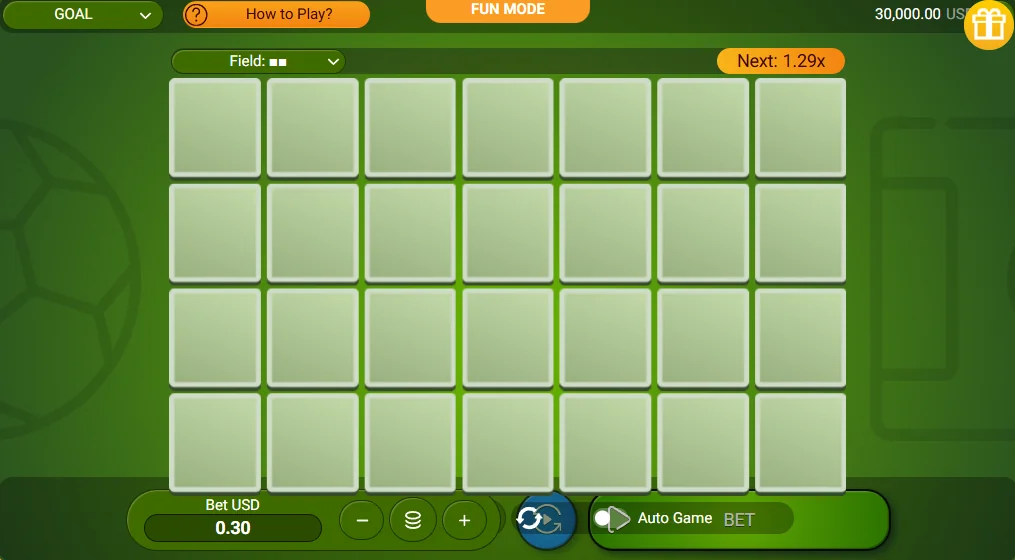
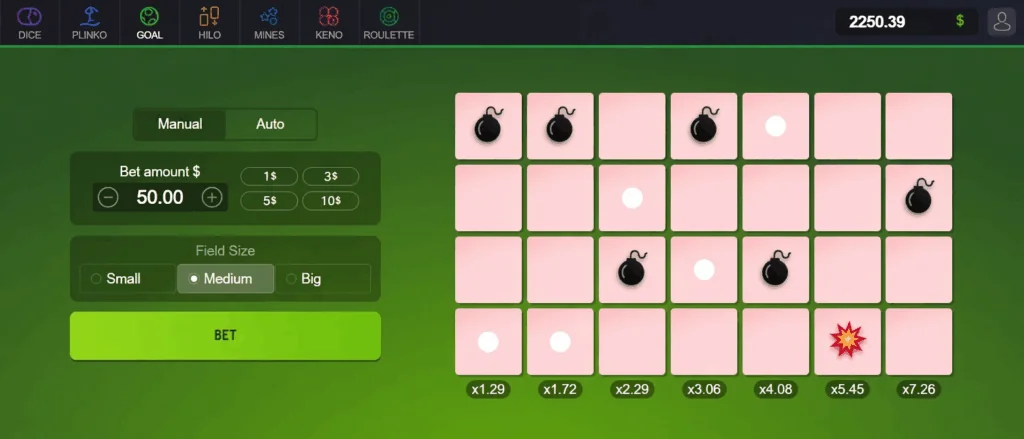
Goal is a football-themed instant game from Spribe, released alongside Mines as part of the studio’s original instant-game line-up built around Aviator. It is not a slot and it has no penalty-shootout mechanic — the previous version of this review attributed it to Endorphina and described a spot-kick sequence, and both claims were wrong. Goal is a grid game: you move a football from left to right across a board, choosing one cell per column, while avoiding exactly one hidden bomb in each column.
Every successful column raises your multiplier, and you can cash out at any point. Hitting a bomb ends the round and forfeits the stake. Because the bomb count per column is fixed at one rather than randomised across the whole board, the probability of every step is exactly calculable — which makes Goal the most transparent game in the Spribe catalogue and the easiest to reason about mathematically.
The Goal RTP is 97%, giving a 3% house edge, and Spribe offers three board sizes. The small grid is three rows by four columns, the medium is four by seven, and the big grid is five by ten. Survival per step is 66.7%, 75% and 80% respectively, while the chance of crossing the entire board falls from 19.8% to 13.3% to 10.7%. Maximum payouts scale accordingly: roughly 4.90x, 7.08x and 9.03x. A perfectly fair big-grid clear would pay about 9.31x; at 97% return it pays around 9.03x.
Easy, Fast, Comfortable
There is no learning curve. Choose a grid, set a stake, tap a cell in the first column, and keep going or cash out. Spribe puts the current multiplier and the next-step multiplier on screen at all times, so every decision is made with the actual numbers visible rather than on instinct.
Rounds are short and entirely self-paced. Spribe includes autoplay and a random-pick option, and neither affects the odds because the bomb positions are locked by the round seed before the first tap. That makes Goal one of the quickest formats in the instant category when you want volume.
A free demo with virtual credits is available. Given how differently the three grids behave — the big board has the best per-step odds but the worst completion rate — running a few dozen demo rounds on each is the sensible way to pick one.
Game Design
Theme and Graphics
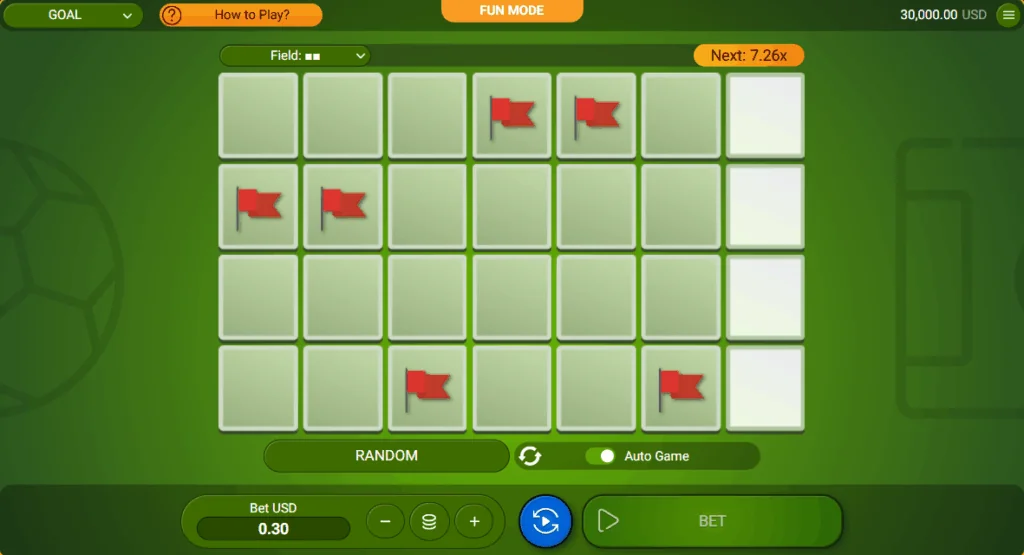
The visual treatment is a stylised football pitch: a green board divided into a grid, a ball marker advancing left to right, and a goal at the far end. Safe cells reveal ball or coin icons and bombs reveal an explosion. Spribe keeps the interface as spare as it does in Mines, with the multiplier readout dominating the layout.
The football skin is cosmetic rather than mechanical — nothing about the sport affects the maths — but it does give the left-to-right progression a natural narrative that a neutral grid would lack. Reaching the goal is simply the state of having cleared the final column.
Sounds and Gameplay Experience
Sound design consists of a crowd murmur, a kick effect on each safe advance and a whistle-and-blast on a bomb. The audio rises as the ball nears the goal, which mirrors the escalating cost of continuing rather than any change in the odds.
The experience is a pure sequence of stop-or-continue decisions, and because Spribe publishes the exact survival probability for each grid, it is unusually honest about what those decisions are worth. Volatility is genuinely high despite the modest ceiling, because a large share of rounds end with nothing at all.
Bets and Payouts
Choosing a Grid
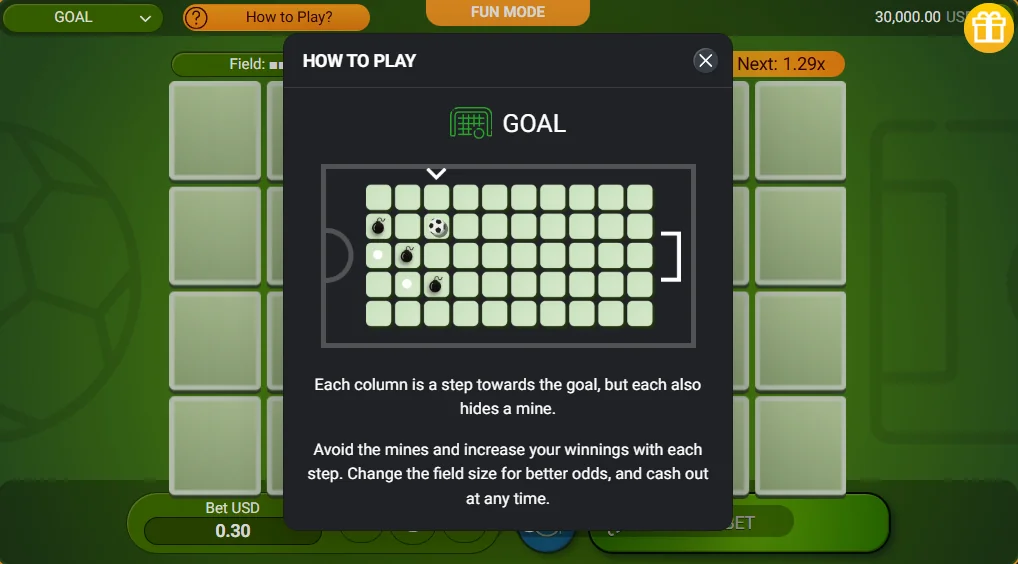
The three sizes are the volatility control. Small (3×4) gives the worst per-step odds at 66.7% but asks you to survive only four columns, so it completes on nearly one round in five for about 4.90x. Big (5×10) is safest per click at 80% but demands ten consecutive survivals, completing on roughly one round in nine for about 9.03x. Medium (4×7) sits between the two at 75% per step and 13.3% completion for around 7.08x.
The Multiplier Ladder
After each cleared column, Spribe recalculates the payout from the remaining columns and applies the 97% return. The next-step figure is always displayed, so you can see precisely what one more column is worth before committing. There are no hidden steps, bonus multipliers or streak bonuses layered on top.
Cashing Out
Cash Out becomes available as soon as the first column is cleared. Since the expected value is identical at every step, when you stop makes no difference to long-run return — but it makes an enormous difference to variance. Partial progress pays nothing if you hit a bomb, so banking early is the only mechanism the game gives you for controlling swings.
No Jackpot
Goal has no jackpot and no bonus round. The ceiling is the full-board clear, which caps out around 9.03x on the big grid. That is deliberately low by casino standards, and it is the clearest structural difference between Goal and its sibling Mines, where high mine counts open up far larger multiples at far worse odds of ever appearing.
Mobile Device Compatibility
Goal was designed for mobile from the outset. The grid scales to the screen width in portrait, cell targets stay large enough for thumb taps even on the ten-column board, and the multiplier and Cash Out controls sit directly beneath the pitch where they are always reachable.
The game is very light on data and processing, which is why Spribe titles run well on entry-level handsets and unstable connections. Round state is stored server-side, so a dropped connection restores the same board and the same standing multiplier when you reconnect.
Advantages and Disadvantages
Advantages
The mathematics is fully transparent. One bomb per column means every probability in the game can be worked out with arithmetic, and Spribe publishes the per-step and full-clear figures rather than hiding them behind a generic RTP number.
Risk selection is meaningful. Three grids with genuinely different survival profiles let the same 97% return be experienced as a quick high-frequency grind or a longer ten-column push, without changing stake size.
It is fast, cheap and provably fair. Rounds take seconds, minimum stakes are low, autoplay is available, and every completed round can be verified against its seed — a combination very few slot alternatives offer.
Limitations
The ceiling is the real problem. About 9.03x is the absolute maximum in the game, and no feature, bonus or lucky sequence can exceed it. Anyone used to three-figure multipliers will find Goal underwhelming regardless of how fair the maths is.
There is no content beyond the loop. No bonuses, no jackpot, no progression and no variation other than the grid size — Goal is one decision repeated, and it wears thin faster than a feature-driven game.
Losses are total. A bomb on the final column of the big grid returns nothing at all despite nine successful picks, and Spribe offers no partial payout or safety net anywhere in the format.
Conclusion
Goal is the most mathematically legible game Spribe makes. One bomb per column, three grid sizes, a published 97% return and a visible multiplier ladder mean there is nothing to discover and nothing hidden — the only question is when you stop. That transparency is its strength, and the roughly 9.03x ceiling is its limitation. If you want a fast, cheap, verifiable alternative to slots and can accept a modest top end, it does the job; if you are chasing large multiples, Mines from the same studio is the better fit.