Mega Ball Game Review by Evolution – RTP & Demo

Game Overview and Basic Information
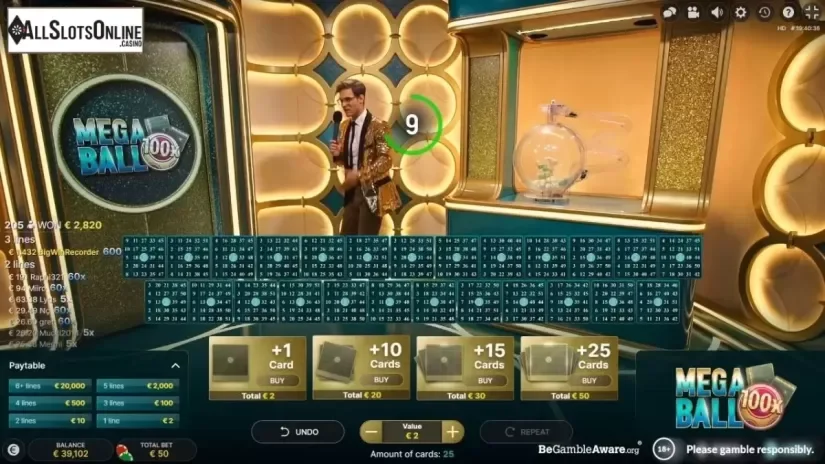
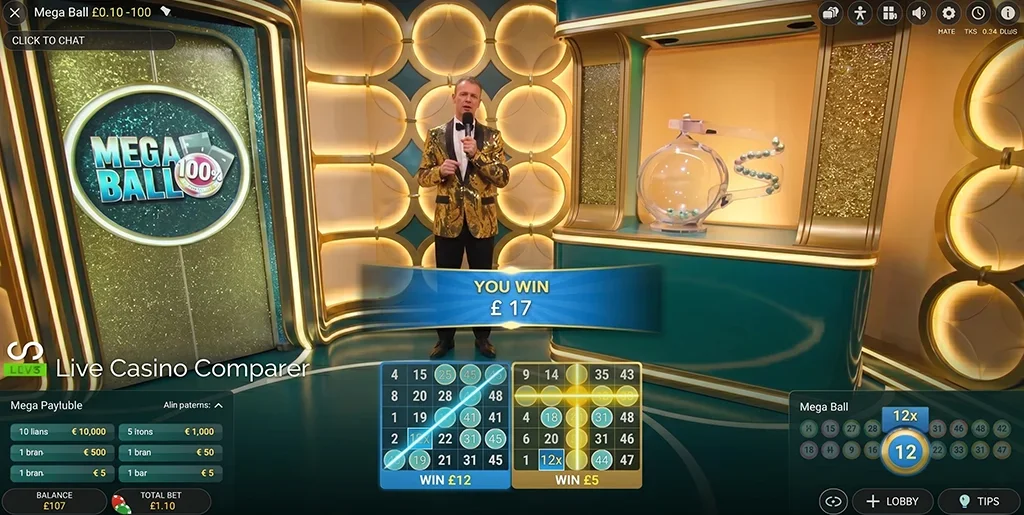
Mega Ball is Evolution bingo game show, launched in April 2020. You buy cards before the round begins, each card is a five-by-five grid of numbers, and a presenter then draws twenty balls from a drum of fifty-one. Every horizontal, vertical and diagonal line you complete on a card pays according to the number of lines that card produced. It is lottery pacing with a television studio in front of it.
The mechanic that gives the show its name comes at the end. After the twentieth ball, a multiplier between 5x and 100x is revealed, and then the Mega Ball itself is drawn. If that final ball completes a line on one of your cards, the multiplier applies to that card entire payout, and because a single ball can complete several lines at once, the biggest results come from a card that was one number short in multiple directions.
The return to player is unusual in that it is not a single number. Independent listings put it between 94.61% and 95.40%, rising with the number of cards you buy, and Evolution allows up to four hundred cards in one round. Our own data file records no RTP for this title, so we use the published range and flag it. The streamed show cannot be played in demo mode, but Evolution released First Person Mega Ball as the RNG version and that build runs free with no registration or deposit.
Easy, Fast, Comfortable
First Person Mega Ball is the free way in. It loads in the browser on play money with no account and no download, draws the same twenty balls from fifty-one, reveals the same 5x to 100x multiplier and applies the same line payouts. That makes it a genuine test of the format rather than a preview, and it is the only way to understand the card-count effect on RTP without spending anything.
Buying cards is the only decision in the game. You choose how many to purchase and at what price per card, and the interface lets you generate new number sets or keep the ones you have. There are no bets to place during the draw and nothing to do once the balls start, so the whole strategic content of Mega Ball sits in the purchase screen.
The display highlights numbers as they are drawn and marks any card that is one ball away from a line, which is what makes the final Mega Ball reveal tense rather than confusing. In the free demo you can run several dozen rounds quickly and watch how often a card actually gets close, which sets expectations far more accurately than reading about the multipliers.
Game Design

Studio and Presentation
The set is bright and deliberately television-like: a large transparent drum with the fifty-one balls visible, a presenter working a live camera, and a wall of screens showing the drawn numbers. Evolution shoots it as a game show rather than as a casino table, with continuous commentary between draws.
First Person Mega Ball rebuilds the same studio in 3D without a human presenter. The drum, the ball animation and the multiplier reveal are all reproduced, so the free demo looks and behaves like the show even though nobody is talking you through it.
Statistics and Trackers
The interface keeps a history of drawn numbers, previous Mega Ball multipliers and the results of your own cards. Because there is no bet selection beyond how many cards to buy, these panels are informational rather than strategic.
The one number worth tracking is your own card count against your spend, since the published RTP range of 94.61% to 95.40% depends directly on it. That relationship is easier to feel in a free demo session, where you can buy four hundred cards without consequence, than at real stakes.
Bets and Payouts
Buying Cards
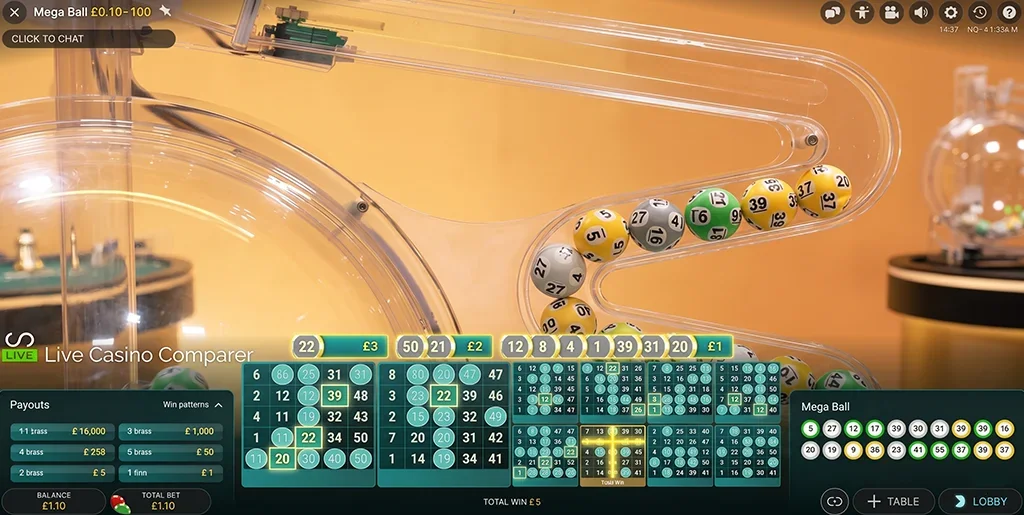
Your stake is the number of cards multiplied by the price per card, and Evolution allows up to four hundred cards in a single round. More cards means more chances of a completed line and a higher effective return, which is why the RTP is quoted as a range rather than a single figure. It also means a larger stake, so the two move together.
Completed Lines
Payouts are per card and scale with the number of lines that card completes, counting horizontal, vertical and diagonal directions. A card with several completed lines pays substantially more than the sum of separate single-line cards would, which is the mathematical reason card quantity matters.
The Mega Ball Multiplier
After twenty balls, a multiplier between 5x and 100x is revealed and colour-coded, then the Mega Ball is drawn. If it completes one or more lines on a card, the multiplier applies to that card whole payout. This is the only source of large wins in the game, and independent listings put the top payout at around half a million in the base currency.
No Jackpot
Mega Ball has no jackpot, progressive or fixed, and our data file confirms this. The 100x Mega Ball multiplier on a multi-line card is the ceiling of the game, capped in absolute terms by the operator maximum payout.
Mobile Device Compatibility
Both the live show and First Person Mega Ball are HTML5 and run in Android and iOS browsers with no app. On a phone the card grid is condensed and the interface prioritises the cards closest to completing a line, which is the right decision when four hundred cards will not fit on a screen.
The RNG version is much lighter because it renders locally rather than streaming a studio feed, so on mobile data it is the practical way to learn the game. Everything you learn about card counts and multiplier frequency transfers directly to the live show.
Advantages and Disadvantages
Advantages
The multiplier is genuinely large. A 100x Mega Ball landing on a card with several completed lines produces a result no conventional bingo game can match.
Buying more cards raises the return, which is unusual: in most casino games stake size has no effect on RTP at all. Here it moves from 94.61% up to 95.40%.
A real free demo exists through First Person Mega Ball, which matters more here than for most games because the card-count relationship is expensive to learn with money.
Limitations
The volatility is high and most rounds return nothing at all. Cards that complete no lines are simply lost, and that is the normal outcome.
The RTP is only good at the top of its range. Buy a handful of cards and you are playing a 94.61% game, which is worse than almost any Evolution table game.
The live show has no demo of its own, and our data file records no RTP for it, so the 94.61% to 95.40% range in this review comes from independent listings rather than from our own records.
Conclusion
Mega Ball is the best-produced bingo format in the live casino market and its maths rewards exactly one behaviour: buying more cards. At the top of its range the return reaches 95.40% and a 100x Mega Ball on a multi-line card is genuinely spectacular, but most rounds pay nothing and a small card count drops the return to 94.61%. First Person Mega Ball lets you test all of that free, and it is worth doing before you decide how many cards a round is sensible for you.