
Pilot Game Review by Gamzix – RTP & Demo
Game Overview and Basic Information
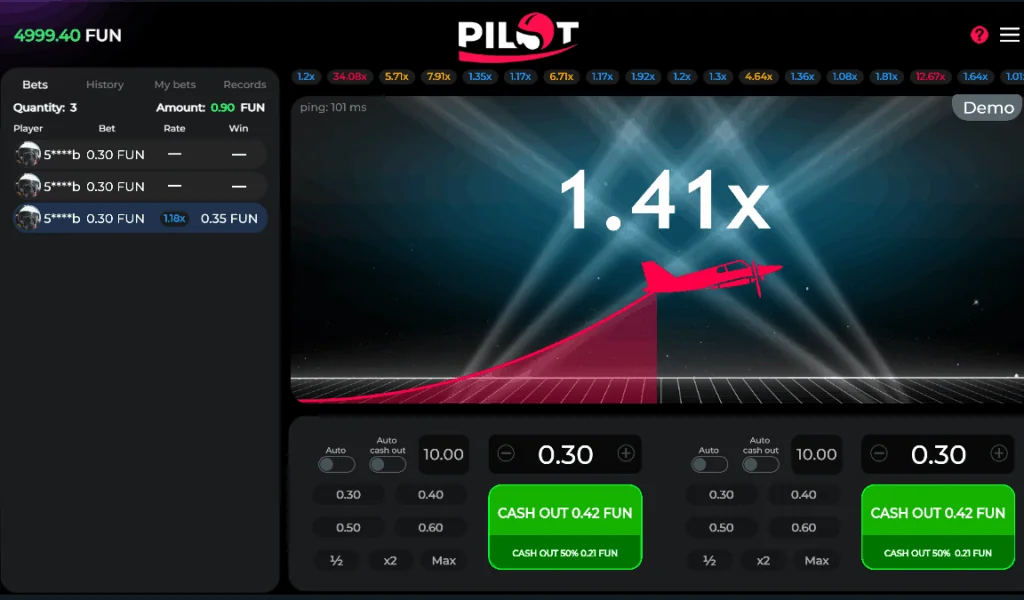
Pilot is a crash game from Gamzix, the Estonian studio, and it takes the aviation format popularised by Aviator and JetX and adds one control that most rivals do not have. A cartoon plane climbs, a multiplier rises from 1.00x, and it keeps rising until the plane flies off. You can collect the whole bet at any moment, or you can press the partial button and lock in half your stake at the current multiplier while the other half keeps flying.
The RTP is 96.5%, giving a house edge of 3.5%, and Gamzix released the game on 28 September 2022. That return is half a point below the very best crash titles, and the trade is explicit: you pay a fraction of a percent for the flexibility of a two-stage cash-out. It is the same arrangement Pragmatic uses in Spaceman, and the underlying maths of the two games is close to identical.
Stakes run from 0.10 EUR upwards on a single bet panel, which places Pilot squarely in casual territory rather than high-roller territory. Our data sheet records a maximum of 10,000x, while independent crash databases list a 5,000x ceiling; we quote the sheet figure here but it is worth checking the in-game info panel at your casino. Rounds are provably fair, with results verifiable through SHA-512 hashing, and a free demo runs the same 96.5% return as the paid game.
Easy, Fast, Comfortable
There is nothing to learn beyond the two buttons. Set a stake, watch the multiplier, and decide when to bank. Full Collect takes everything at the current value. Partial Collect secures half and leaves half in the air, which you then close out separately at whatever the multiplier has reached by the time you press again.
That second button is what makes Pilot worth playing rather than simply another plane game. The standard use is to take the partial cash-out at a low multiplier to guarantee the round does not lose you money, then let the remaining half chase something substantial with the pressure removed. Gamzix has effectively built a hedging tool into the interface, and it changes the psychology of a crash round considerably.
Auto cash-out is available for players who would rather not rely on reaction time. Set a target and the game banks automatically the instant the multiplier reaches it. Combining a low auto target with a manual partial cash-out is the approach most regulars settle into, and rounds are short enough that a session builds quickly.
Game Design
Theme and Graphics
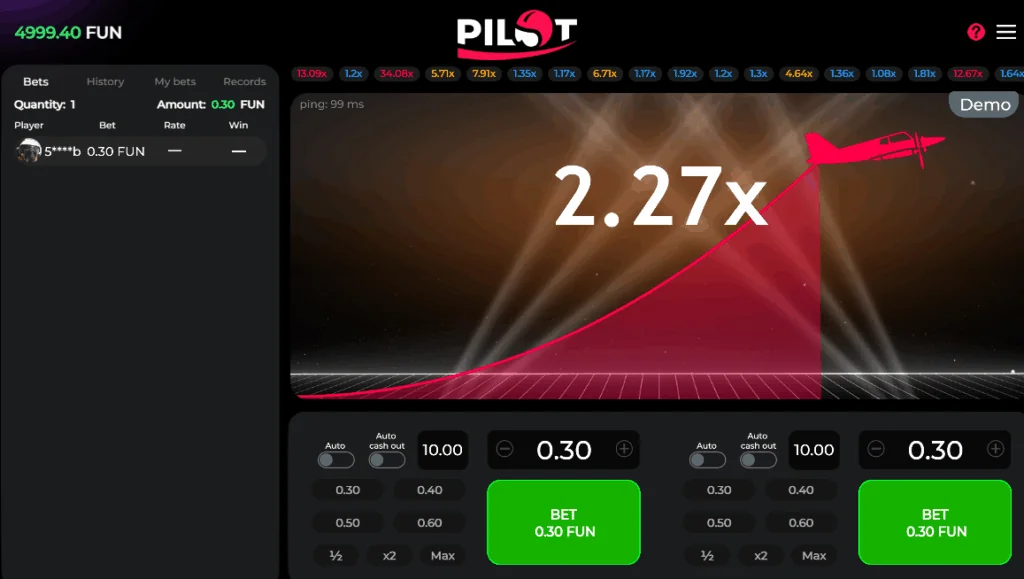
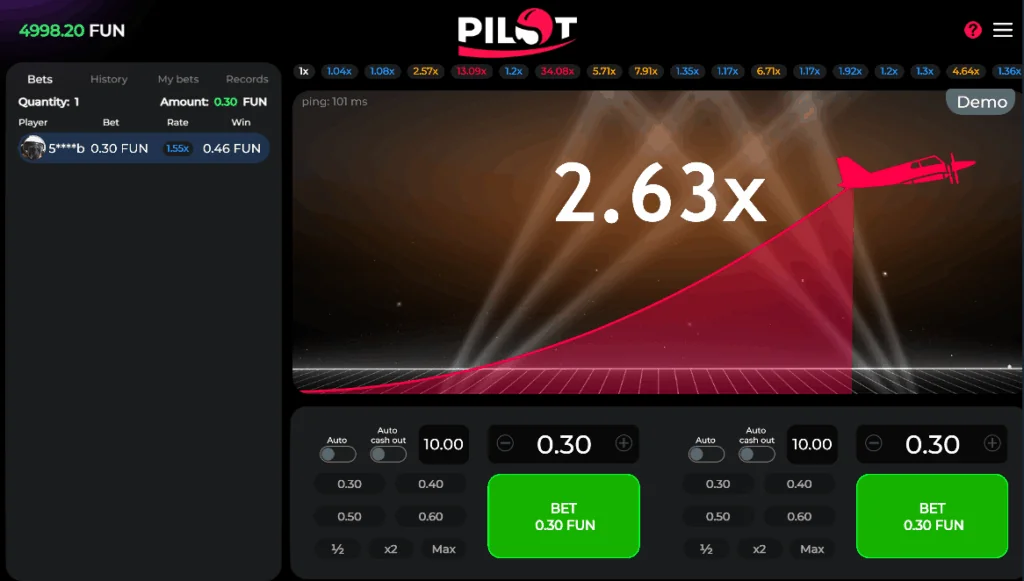
The visual style is bright cartoon aviation: a friendly propeller plane, layered cloud parallax, a clear blue sky and a large multiplier rendered in the centre of the screen. Gamzix has not attempted realism, and the choice is sensible, because in a game decided by tenths of a second the priority is that the number is impossible to misread.
The interface keeps everything on one screen: bet amount and the two collect buttons at the bottom, a history strip of previous crash points along the top, and a live feed of other players cashing out to the side. Nothing is hidden in menus, and the partial cash-out button is visually distinct from the full one so the wrong press is unlikely.
Sounds and Gameplay Experience
Audio is built around the propeller, which rises in pitch as the multiplier climbs and cuts out abruptly on the crash. A separate chime confirms each cash-out, and because Pilot has two of them, you hear two distinct confirmations in a round where you use the partial button. That small detail helps a lot when the pace is quick.
The experience is more measured than most crash games precisely because of the partial button. Instead of a single all-or-nothing decision, you are making two related judgements, and the second one is taken with money already banked. Players who find pure crash games too tense often get on better with this format from Gamzix than with Aviator.
Bonuses and Features
Partial Cash-Out
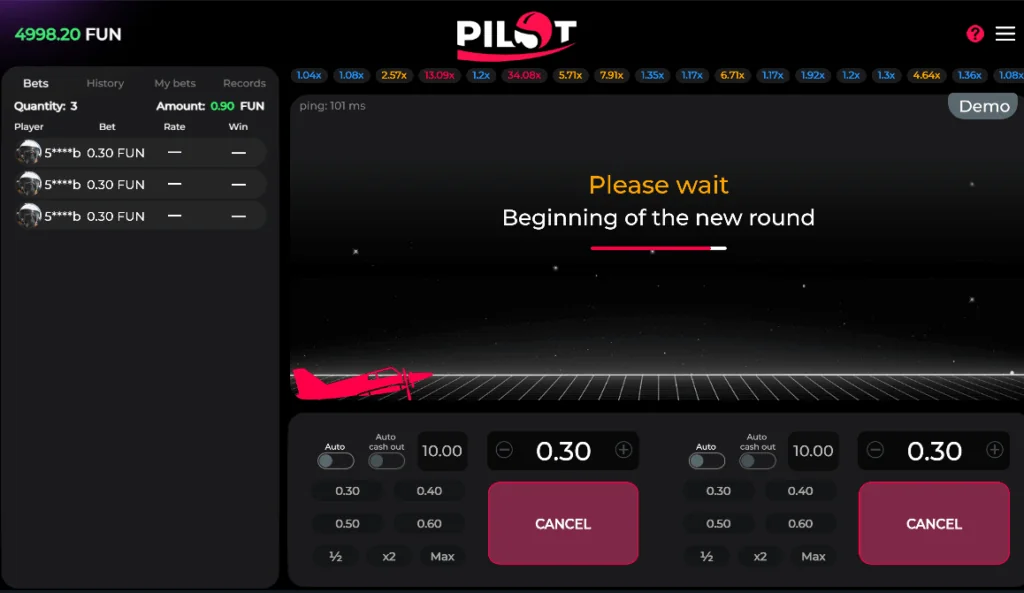
The signature mechanic. At any point during a flight you can collect 50% of your stake at the current multiplier while the remainder stays in play. There is no fee for using it beyond the half point of RTP that Gamzix charges across the game. The strategic value is that you can secure a break-even or better outcome early and then take a genuine swing with the rest, which is not possible in a single-button crash game.
Auto Cash-Out and Auto Play
The auto cash-out field accepts any target above 1.01x and fires the moment the multiplier reaches it, removing human latency from the equation entirely. Auto play can be limited by round count or by a loss ceiling, and setting that ceiling is sensible advice in any crash game, however low the volatility rating.
Provably Fair Verification
Gamzix publishes a verifiable fairness system for Pilot based on SHA-512 hashing, so the crash point of each round can be checked after the fact rather than taken on trust. The game has been in the market since 2022 with no publicly confirmed fairness disputes, and it is distributed through a broad network of operators under Malta and Curacao licensing.
No Jackpot
Pilot has no progressive jackpot, no in-game jackpot ladder and no free spins, because none of those things exist in the crash format. The only route to a large win is a long flight, and the ceiling recorded in our data sheet is 10,000x. Independent databases list 5,000x for this title, so treat the higher number as the provider-side figure and verify at your casino.
Mobile Device Compatibility
The game is HTML5 and runs directly in a mobile browser with no download. Gamzix has sized both collect buttons generously and placed them low on the screen where a thumb naturally rests, which matters more here than in most games because two separate presses may be needed inside a few seconds.
Graphics are lightweight and there is no video stream, so Pilot performs well on modest hardware and tolerates a weak connection better than a live table would. Latency still costs money in a crash game, though, so if your signal is unreliable the auto cash-out target is the safer way to play on mobile.
Advantages and Disadvantages
Advantages
The partial cash-out is a genuine differentiator. Very few crash games offer it, and it converts a binary gamble into something you can actually manage, which makes Pilot a reasonable entry point for anyone who has found the genre too unforgiving.
Volatility is on the low side for a crash game. Combined with a 0.10 EUR minimum stake, that makes Pilot one of the more approachable titles in the category and suitable for long, low-cost sessions rather than short, brutal ones.
Transparency is a real plus. Gamzix publishes the fairness verification method, the RTP and the house edge, and the demo runs the identical maths, so nothing about the game requires you to take the studio at its word.
Limitations
The 96.5% RTP is a step down from the strongest crash games, some of which run at 97% or better. Half a percentage point is small in absolute terms but it is a real cost, and it exists specifically to fund the partial cash-out you may or may not use.
There is very little content. No symbols, no bonus round, no progression and no collectibles means the game relies wholly on the tension of the flight, and it will feel repetitive to anyone who plays for features rather than for odds.
Bet limits are mid-range, so high rollers will find the ceiling restrictive, and published data on the maximum multiplier is inconsistent between our data sheet and third-party databases. Distribution also runs through a smaller aggregator network than the biggest crash brands, so availability varies by operator.
Conclusion
Pilot is Gamzix taking a crowded format and adding the one thing it was missing. The 50% partial cash-out gives you a way to bank a round and still chase a big multiplier, low volatility and a 0.10 EUR minimum make it unusually approachable, and a published 96.5% RTP with verifiable SHA-512 fairness means the terms are clear. It gives up half a point of return compared with the sharpest crash games and it offers nothing at all in the way of features, so purists on either side may look elsewhere. For most players, though, the two-button design is worth more than the half point it costs, and the free demo lets you decide that for yourself.