Super Sic Bo Game Review by Evolution – RTP & Demo

Game Overview and Basic Information
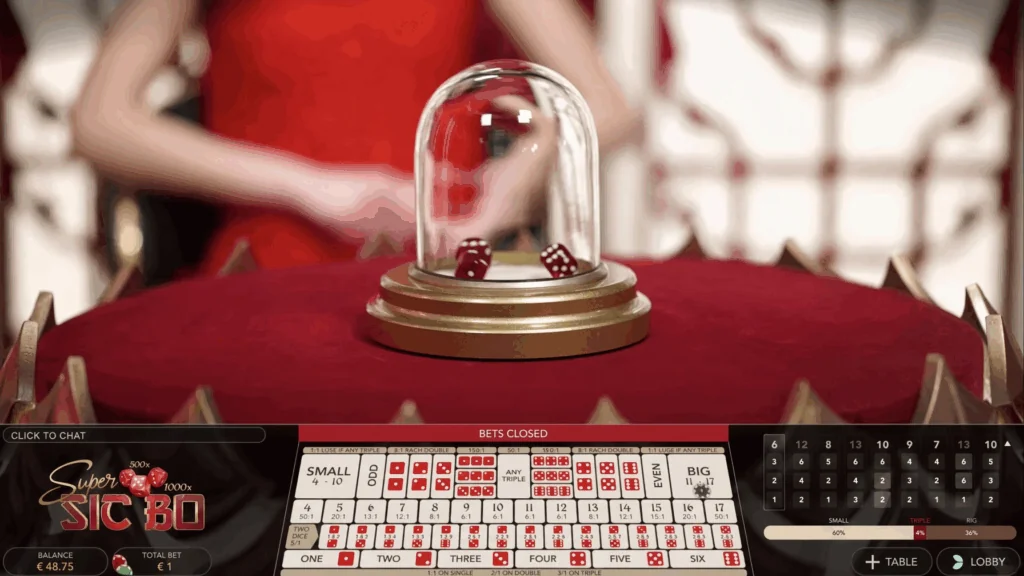
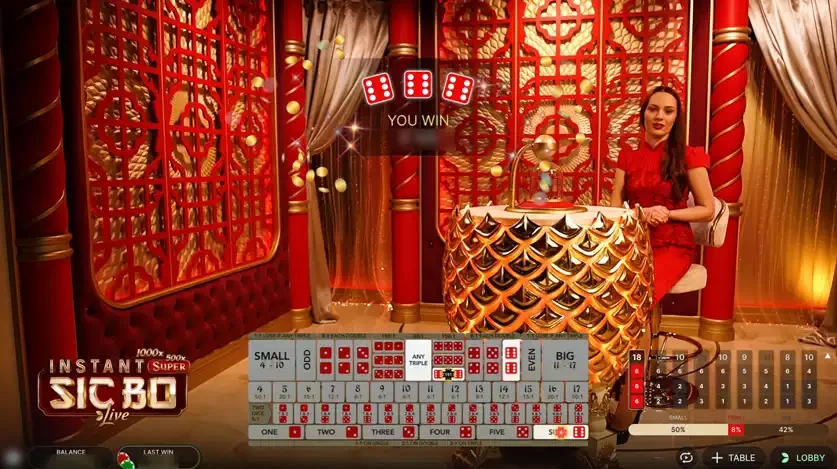
Super Sic Bo is Evolution’s multiplier edition of the three-dice game that has been played across Asia for centuries. Evolution added the table to its live lobby in April 2019, and the format stays simple: a presenter seals three dice inside an automatic shaker, and before the shake the game engine paints random multipliers on to one or more payout positions on the felt. If the dice then settle on a position that has been lit up, the win is multiplied by the figure shown, all the way up to 1,000x.
Our data sheet lists the Evolution Sic Bo family, including the Speed Super Sic Bo table, without an RTP figure and without a release date, so the numbers quoted here come from Evolution’s published paytable and from independent game databases rather than from the sheet. The theoretical return is 97.22% on the Small/Big and Odd/Even positions and falls to about 95.02% on the weaker corners of the layout. That spread is normal for Sic Bo, because the game is really a bundle of separate wagers, each carrying its own house edge.
One point needs stating plainly, because it decides how you can try the game without money. The live Super Sic Bo table is a broadcast with a human presenter and a physical shaker, so the streamed table has no demo mode at all. Evolution solves this with First Person Super Sic Bo, the RNG twin of the same game: the same bet layout, the same multiplier engine up to 1,000x, rendered in a 3D room instead of a studio, and playable free with no registration and no download. That free RNG version is exactly what the demo button on this page leads to, and it carries a GO LIVE shortcut into the streamed table once you are ready.
Easy, Fast, Comfortable
The reason Evolution keeps investing in Sic Bo is that the game asks almost nothing of a newcomer. There is no strategy chart to memorise and no correct decision to get wrong: you place chips, the dice are shaken, and the felt pays whatever the three faces add up to. Even the multiplier layer needs no input from you, since the engine chooses the lucky positions on its own before the shaker is released.
Rounds are short. The betting window runs for roughly fifteen seconds, the shake and reveal take a few more, and the table is open again. Repeat-bet and double-bet buttons let you carry a full pattern of chips from one round to the next with a single tap, and the favourite-bets panel stores layouts you use often. Over a session that pace means a lot of rounds, which is precisely why practising first in the free version is worth the time.
The First Person build flattens the learning curve further. Because the demo runs on a random number generator, you can sit at the table for as long as you like with play money, watch how often the multipliers actually land, and get a feel for how much of the felt a comfortable stake really covers. Nothing about the paytable changes between the demo and the live studio, so the habits you build carry straight over.
Game Design
Studio and Presentation
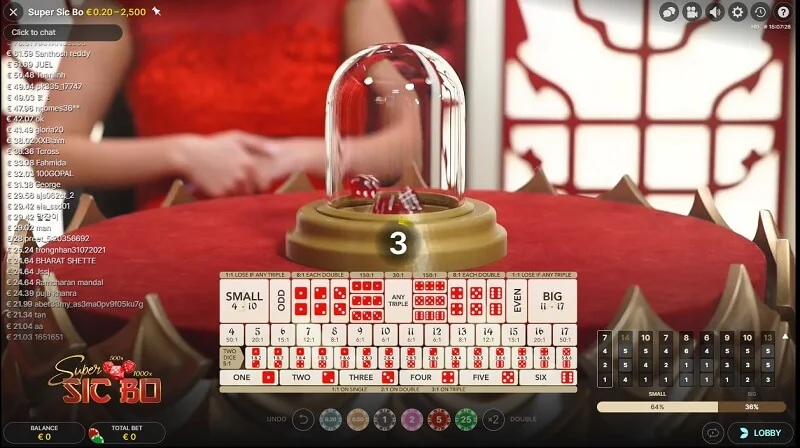
The live table is streamed in high definition from Evolution’s studios, with the shaker mounted centre-frame and a wide-angle camera on the felt. Presenters work in short shifts and keep commentary light, and the multiplier animation, a burst of electricity across the chosen positions, is the visual centrepiece of every round. Evolution built the set so that the dice are visible from the moment the lid lifts, which matters for a game whose whole appeal is a verifiable physical result.
First Person Super Sic Bo replaces the studio with a rendered room. The shaker, the felt and the multiplier effects are recreated in 3D, and because the outcome comes from a certified random number generator the round can resolve in a couple of seconds. Visually it is a different product, but the numbers on the paytable are the ones Evolution publishes for the live table, which is what makes the demo a fair rehearsal rather than a toy.
Statistics and Trackers
Both versions ship with the statistics panel Evolution uses across its dice and wheel games: a history strip of recent totals, a heat map showing which numbers have been running hot, and counters for Small, Big, Odd and Even. None of it predicts anything, since each shake is independent, but players who like to bet in patterns find the display useful for keeping track of what they have been doing.
The demo is the better place to read those panels for the first time. In the live room the fifteen-second window puts pressure on you, whereas in the free First Person table you can stop and study the layout for as long as you want. Evolution deliberately keeps the interface identical between the two, so time spent in the demo is not wasted.
Bets and Payouts
Small, Big, Odd and Even
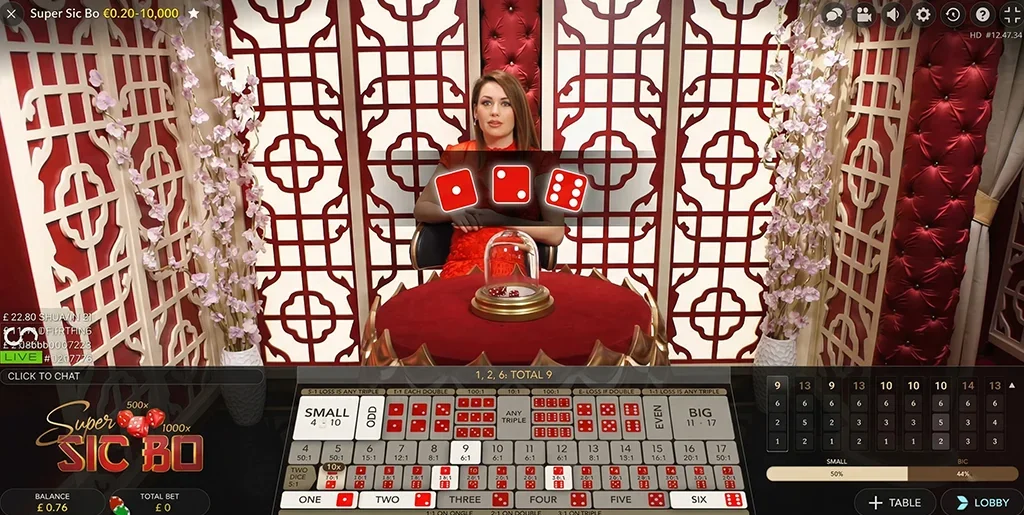
These four positions are the backbone of the table and the reason the 97.22% figure gets quoted. Small covers totals from four to ten, Big covers eleven to seventeen, and Odd and Even do exactly what they say. All four pay even money and all four lose on any Triple. They are also the positions most likely to be hit by a multiplier over a long session, simply because they come in so often.
Totals, Doubles and Triples
Betting a specific total pays according to how many dice combinations produce it, from 6 to 1 on a total of ten or eleven up to 150 to 1 on a total of three or eighteen. A Specific Double pays 8 to 1 and a Specific Triple 150 to 1, with the Any Triple position paying 24 to 1. These are the positions where a multiplier turns a modest hit into the kind of result that gets clipped and shared, and where the 1,000x ceiling actually becomes reachable.
Combinations and Single Numbers
The Combination positions ask for two named faces to appear together and pay 5 to 1, while the Single Number bets pay 1 to 1, 2 to 1 or 3 to 1 depending on how many of the three dice show your face. This part of the felt is where the theoretical return is at its lowest, closer to the 95.02% end of the range, so it is worth understanding before you spread chips across it. The demo is a cheap way to find that out.
No Jackpot
There is no progressive jackpot attached to Super Sic Bo, and our sheet agrees, marking the Evolution dice tables as carrying no in-game jackpot. The random multiplier system is the replacement: instead of a slowly growing pool, every round has a chance of turning an ordinary position into a heavily boosted one. The practical ceiling on a single round is 1,000x the stake on a multiplied bet.
Mobile Device Compatibility
Evolution builds its dice tables mobile-first, and Super Sic Bo runs in a phone browser without an app. The portrait layout stacks the video at the top and gives the felt a scrollable, zoomable grid, so a fifty-position table stays usable on a small screen. Landscape mode restores the desktop arrangement for anyone who prefers it.
The First Person demo is the lighter of the two on a mobile connection, since it streams no video at all. If you are on a patchy network, that version is the sensible place to learn the layout, and it is also the version that lets you practise on the move without spending anything. Both builds are supported on current versions of iOS and Android.
Advantages and Disadvantages
Advantages
The headline advantage is that Evolution gives this game a genuine free route in. First Person Super Sic Bo is a full RNG implementation with the same bet layout and the same multiplier engine, and it opens without an account, so nobody has to fund a balance just to see whether they enjoy three-dice betting.
The multiplier layer is generous by design. Unlike some of Evolution’s Lightning titles, Super Sic Bo charges no extra fee for the boosted positions, so the 97.22% return on the even-money bets is not eroded by a surcharge. Multipliers can reach 1,000x and are applied before the shake, which keeps the round honest and easy to follow.
Finally, the game is complete. Evolution kept the full traditional felt rather than trimming it, so more than fifty positions are available, from even-money bets that come in constantly to Specific Triples that pay 150 to 1. That range means the same table works for a cautious player and for someone chasing a single large result.
Limitations
The most important limitation is the one we started with: the live studio table has no demo. Everything you can try for free happens in the First Person RNG version, and while the maths matches, the experience does not. A rendered room cannot reproduce a presenter’s pacing, the sound of a real shaker or the multi-camera production that makes the live table feel like a broadcast.
The return is also uneven across the felt. At 97.22% the even-money bets are competitive, but the Single Number and Combination positions sit closer to 95.02%, and a player who scatters chips everywhere is effectively choosing the worse end of that range. Sic Bo rewards knowing which positions you are actually paying for.
Lastly, the multipliers cannot be steered. They are assigned at random before each shake, so there is no way to bet into them deliberately, and a long stretch of rounds where the boosted positions never coincide with your chips is entirely normal. Anyone who dislikes that kind of variance will find the plain Sic Bo tables in the Evolution lobby a better fit.
Conclusion
Super Sic Bo is Evolution at its most straightforward: an ancient dice game, a full traditional felt, and a multiplier system that adds a 1,000x ceiling without charging for it. The 97.22% return on the even-money positions is solid, the 95.02% floor on the exotic ones is the price of variety, and the fifteen-second rounds keep everything moving. Because the streamed table cannot be demoed, the honest way in is First Person Super Sic Bo, the free RNG twin with the same paytable, and we would suggest a session there before any money changes hands.