
Zeus Rush Fever Deluxe Slot Demo – Honest Review, RTP & Volatility

Game Overview and Basic Information
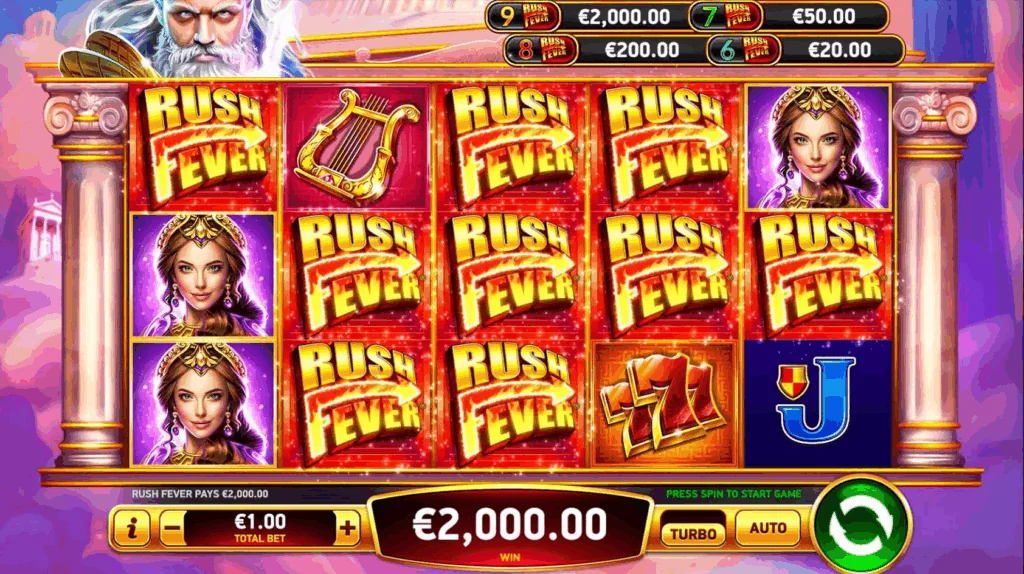
Zeus Rush Fever Deluxe is a video slot developed by RubyPlay, built on the mythology of the Greek god Zeus. The game runs on a 5-reel grid with 243 ways to win rather than fixed paylines. Its return-to-player rate sits at 96.56%, slightly above the industry median. The volatility classification is low-to-medium, meaning wins arrive at a fairly steady cadence with a high hit frequency (around 38.6%) rather than clustering into rare bursts.
The max win potential reaches up to 4,501x the total bet, driven by the Rush Fever free spins and jackpot features rather than a progressive structure. Base game hits are frequent at low-to-mid values thanks to the 243-ways engine and the high hit frequency, while the largest payouts concentrate inside the bonus rounds. The minimum bet starts at $0.40, with a ceiling of $100 per spin.
This is not a straightforward reskin of the classic Zeus slot. The “Deluxe” designation carries mechanical weight – specifically referencing the Rush Fever feature, which triggers an escalating free spins multiplier system that does not reset between retriggering events. That distinction separates this title from its predecessors in a measurable way.
Easy, Fast, Comfortable
The control layout follows RubyPlay’s standard interface logic: spin, autoplay, and bet adjustment are positioned along the bottom panel without requiring any navigation through submenus. Bet increments adjust in discrete steps rather than a slider, which some players find limiting when targeting a precise stake. The autoplay function includes loss limit and win cap settings – a practical inclusion for session management.
Loading times across desktop browsers are consistently short. The game initializes within seconds on standard broadband connections, and there is no mandatory registration to access the demo version on most licensed platforms. Free play is available without deposit, which removes friction for players evaluating the volatility behavior before committing real money.
The paytable is accessible through a single-tap icon and displays all symbol values, bonus trigger conditions, and feature rules in a structured format. Nothing is buried. For a low-to-medium-volatility slot, having transparent access to payout logic matters – players calibrating bet sizing relative to bankroll need that data immediately, not after three navigation steps.
Game Design
Theme and Graphics
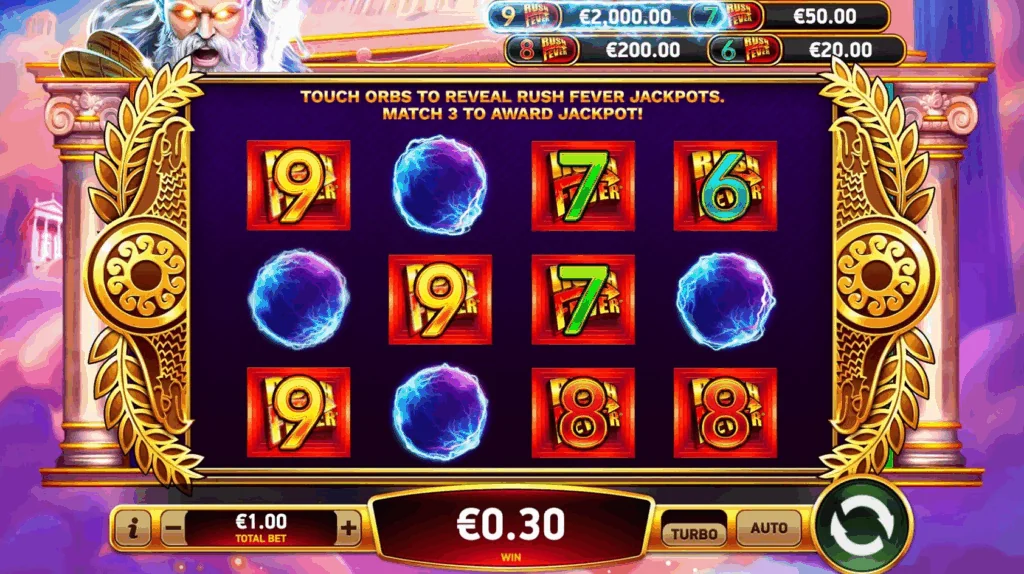
The visual direction draws from a stylized interpretation of ancient Greek mythology – not archaeological accuracy, but cinematic dramatization. Zeus is rendered with electric blue detailing, flanked by lightning motifs and storm-cloud backgrounds. The color palette leans heavily into electric blues, gold accents, and dark storm grays, creating contrast that keeps the reels readable even during rapid spin sequences.
Symbol artwork is sharp and distinct. Premium symbols are hand-drawn with enough detail to differentiate them at a glance, while lower-value card symbols are styled to match the mythological aesthetic rather than appearing as generic placeholders. The overall visual production sits comfortably in the upper tier of RubyPlay’s catalog, though it does not push graphical boundaries beyond what the engine supports.
Reel animations during wins are proportional to payout size – minor wins generate subtle lighting effects, while larger combinations trigger more prominent visual sequences. This graduated feedback system reinforces the payout hierarchy without overwhelming the screen.
Sounds and Gameplay Experience
The soundtrack operates in two distinct modes. During base game spins, a restrained orchestral loop plays at low intensity – present without being intrusive. When the Rush Fever bonus activates, the audio shifts register entirely: tempo increases, thunder effects layer in, and Zeus’s voice lines punctuate key moments. The transition is intentional and effective at signaling a shift in game state.
Sound design for individual spin events is calibrated precisely. Near-miss audio patterns are absent – a deliberate choice that avoids manufactured tension around non-winning spins. Win sounds scale with payout value, which keeps audio feedback informative rather than performative. Extended sessions remain aurally tolerable, which is not always the case with mythologically themed slots that tend toward bombast.
Bonuses and Symbols
Symbols in the Game
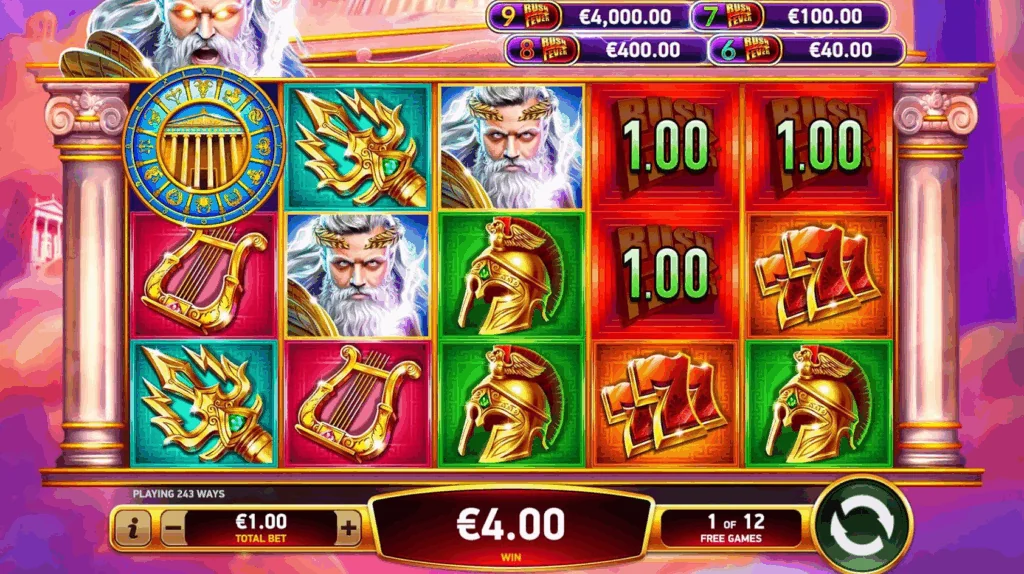
The symbol hierarchy in Zeus Rush Fever Deluxe consists of seven distinct categories. Zeus himself functions as the highest-value regular symbol, paying 25x the line bet for five of a kind. Below him, an eagle, a helmet, a shield, and a thunderbolt occupy the mid-tier premium positions. Standard playing card symbols (A, K, Q, J) fill the lower-value slots.
The Wild symbol substitutes for all standard symbols and appears on reels 2, 3, and 4 exclusively – it does not trigger paylines independently. The Scatter symbol, depicted as a lightning bolt column, activates the bonus round and can land on any reel. No stacked wilds exist in the base game; that mechanic activates only during the Rush Fever phase.
Bonus Rounds and Free Spins
Three Scatter symbols anywhere on the reels trigger the Rush Fever Free Spins feature, awarding 8 initial free spins. What distinguishes this from a standard free spins round is the accumulating multiplier mechanic. Each time a Wild symbol lands during the bonus, it contributes to a persistent win multiplier that carries over across all remaining and retriggered spins – it does not reset.
The feature can retrigger: landing 2 or more Scatters during the free spins phase adds 5 additional spins to the current count. There is no upper cap on retriggering, which means extended bonus sessions with elevated multipliers are theoretically possible, though statistically infrequent. The absence of a multiplier reset on retrigger is the mechanical detail that drives the title’s max win potential.
During the Rush Fever phase, Zeus Wilds appear stacked on reels 2, 3, and 4, significantly increasing reel coverage relative to the base game configuration. Full-reel wild stacks on multiple reels simultaneously represent the highest-value bonus state in practical terms.
Paytable and Winning Combinations
Wins are evaluated on a 243-ways basis, paying left to right from reel 1 when matching symbols land on consecutive reels regardless of row position. Zeus is the top standard symbol, followed by the eagle, helmet, shield and thunderbolt in descending order, with card ranks filling the low-pay tier. Payout values scale proportionally with the total stake.
Premium symbols carry a clear payout advantage over the card ranks, but the wide 243-ways coverage and high hit frequency mean small and mid-size wins land regularly. This distribution reinforces the low-to-medium volatility classification: the game sustains the bankroll steadily rather than relying on rare high-variance spikes.
Jackpot
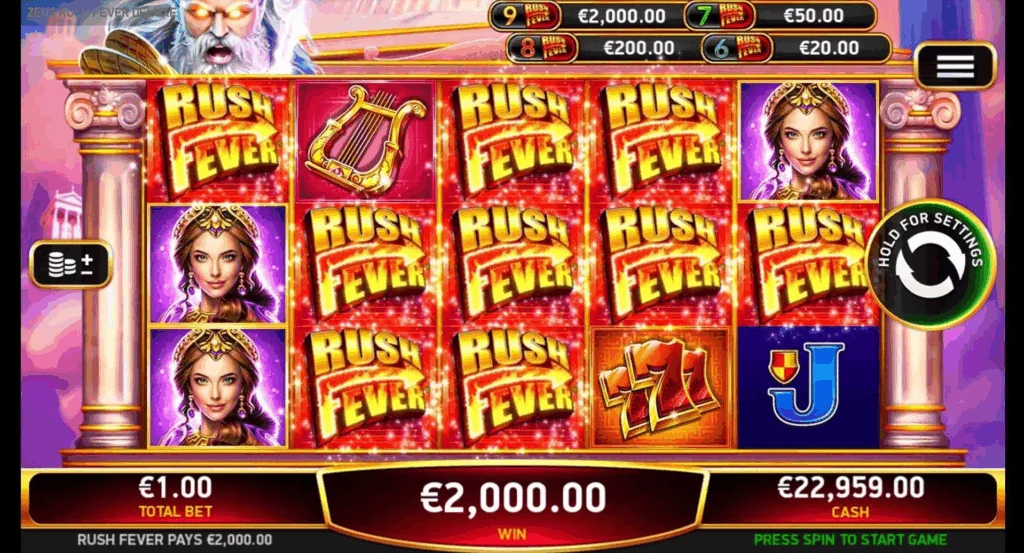
Zeus Rush Fever Deluxe does not feature a progressive jackpot. The maximum payout ceiling is fixed at 4,501x the total bet, achieved through the cumulative multiplier mechanic within the Rush Fever bonus. There is no separate jackpot symbol, jackpot trigger event, or networked prize pool connected to this title. Players seeking progressive jackpot exposure will need to look elsewhere within the RubyPlay catalog.
The fixed max win structure means variance behavior is predictable and bounded. For bankroll planning purposes, the absence of a jackpot component simplifies session expectations – peak wins are constrained, but the probability distribution is more calculable than progressive-linked alternatives.
Mobile Device Compatibility
The game uses HTML5 technology, which means it runs natively in mobile browsers without requiring any application download. Performance on mid-range Android devices is stable, with no observable frame rate degradation during bonus animations. iOS performance is consistent across tested versions of Safari, with touch controls responding accurately to bet adjustment and spin commands.
The interface scales to portrait and landscape orientations. In portrait mode, the reel area occupies the upper two-thirds of the screen, with controls condensed below – the layout remains functional though slightly compressed. Landscape mode restores the full desktop proportions and is the preferred orientation for extended play sessions on phones with smaller screens.
Autoplay functions fully on mobile, including the loss limit settings. The paytable renders legibly on 5-inch screens without requiring zoom. No touch-specific features are added beyond basic navigation adaptation – this is a direct port rather than a mobile-native design, but the implementation is clean enough that the distinction rarely matters in practice.
Advantages and Disadvantages
Advantages
The non-resetting multiplier mechanic during retriggered free spins creates a genuine escalation dynamic that most low-to-medium-volatility slots replicate only in theory. The RTP of 96.56% is consistent and verified across licensed platforms. Bet range accessibility – starting at $0.40 – allows meaningful session length at conservative stakes without trivializing the volatility curve.
Demo availability without registration lowers the evaluation barrier substantially. The paytable transparency, combined with straightforward bonus trigger conditions, means players can form accurate expectations before real-money sessions. The audio design avoids the near-miss manipulation patterns found in some competing titles, which is a notable absence worth registering.
Limitations
The 4,501x max win, while solid, is not in the extreme-upside tier that some high-variance titles reach – this is a steadier, lower-volatility game by design, so players chasing five-figure multipliers should calibrate expectations. The stacked Wild mechanic is confined to the bonus round, so base-game spins rely on the 243-ways hit frequency rather than feature drama.
The visual design, while competent, draws on a mythological theme that has been executed repeatedly across the RubyPlay catalog and the wider industry. There is nothing visually surprising here. The card symbol presence in the lower pay tier is a dated design choice that newer slots have largely moved away from, and their contribution to meaningful wins at low-to-medium volatility is negligible.
Conclusion
Zeus Rush Fever Deluxe occupies a specific position in the low-to-medium-volatility slot category: technically sound, mechanically transparent, and built around one core feature that either delivers or doesn’t depending on how the multiplier accumulates. The 96.56% RTP is legitimate, the free spins structure has genuine escalation logic, and the demo access makes evaluation straightforward.
The game’s identity is a steadier, low-to-medium-volatility Greek-myth slot rather than a high-ceiling gamble. The 4,501x max win, the frequent 243-ways hits, and the Rush Fever multiplier feature together form a coherent package. Players expecting relentless high variance should look elsewhere, but for balanced, feature-driven play the design holds together well.